Thursday, October 6, 2016

Getting Ready to Meet Birding Clubs in Honduras

          Less than one week to go before I head to Honduras to meet with Birding Clubs there about the idea of establishing a network of sister clubs between Central and North America.  Many of the bird species that we think of as our "birds of summer" are experiencing steep population declines.  One of the major culprits is habitat loss in both breeding and wintering areas.  As a birder living the in northeastern U.S., I know first-hand how much the dawn chorus of birdsong has diminished over the last couple of decades.  Next week, I'll get to see first-hand what the habitat conditions are like where some of "our" birds, like Wood Thrush, Golden-winged Warbler, Baltimore Oriole, and Rose-breasted Grosbeak overwinter. 

          To get ready for my trip, I have been studying about Honduras, trying to bone up on my limited skill at speaking Spanish, and of course learning all I can about the birds I'll see in Honduras.  Luckily for me, I have the privilege of getting my hands on a copy (well, 16 copies actually) of the brand new Peterson field guide to birds of northern Central America by Jesse Fagan and Oliver Komar.  This book came off the presses at the beginning of October, just in time for the Honduras Birding Tour for Conservation.  It also will come in handy when I participate in the Lake Yojoa Birding Blitz where I will meet some of the members of the Tautunas Birding Club from the city of Gracias in Lempira department. 

         What am I going to do with 16 copies of this field guide, you ask?  I'll be hand-carrying these down to Honduras to give to co-author Oliver Komar at Zamarano University where they will be used for educational purposes.  It's a great field guide, covering Guatemala, Belize, El Salvador, and Honduras.  The book illustrates and describes 827 species of birds that occur regularly in northern Central America, including the 763 species that are possible to see in Honduras. 

          My plans for meeting with Birding Clubs in Honduras continue to evolve and firm up.  Last night and this morning I've been working on arrangements for meeting with members of the Cotinga Bird Club in La Ceiba on the north (Caribbean) coast in Atlantica department.  This is one of six clubs in the country with whom I hope to interact during my trip.  Remember that you can follow along with my travels on this blog.  Plus, it's still not too late to help support my in-country travels at my Go Fund Me campaign. 

          Excitement is building.  Now it's time to get back to studying! 

Tuesday, October 4, 2016

Getting ready to see our "Birds of Summer" at their homes in Honduras


          I leave for Honduras a week from tomorrow.  Part of my trip will be devoted to meeting with local birding clubs in Honduras to explore the idea of establishing a network of sister birding clubs in North and Central America. 

          I envision several specific outcomes from establishing the network of sister birding clubs.  Initially, we can start a virtual relationship through which we skype, share slides, stories, etc. of what is going on with migratory birds in our areas (e.g., timing of migration, species, seen, pictures and video of the habitats used by these birds, relationship (or lack of relationship) between these birds and the lives and livelihoods of birding club members, etc.).  North American clubs can obtain and donate resources (e.g., optics, field guides, etc.) to Central American clubs, which largely lack these resources.  Ultimately, I envision some reciprocal visits.  Nort Americans can go visit the small communities where these Honduran clubs occur, stay in local (not ecotouristic lodges) accommodations, eat in local restaurants, and make a commitment to buy shade-grown coffee.  I’d also love to have kids in the clubs start a pen-pal kind of relationship with each other.  The ideas and possibilities are endless.  I hope to learn from them what would be useful and meaningful when I am in Honduras.


Members of the Cayuga Bird Club in Ithaca, NY scanning Cayuga Lake
for birds in the late fall.  What birds that either breed in NY or pass
through on migration will I see in Honduras?  Photo credit: Jody Enck
          What benefits to North American clubs do you think could come out of a network of sister birding clubs linking the migratory pathways of Neotropical migratory birds?  Put your ideas in the comments section and I'll post about them in the future.

          It's not too late to donate travel funds to this project.  Please go to this link to support my travel within Honduras to meet with the local birding clubs there.  Thanks!


Sunday, October 2, 2016

Filling the Larder for the Winter


I always am interested in noting the behavior of the birds I am watching.  The birds in my local patch have telling me a lot lately by their actions.  In particular, the feeding behavior of the birds has really caught my attention over the last couple of weeks.  The Neotropical migrant warblers passing through my patch on their way south to their respective wintering grounds have been feeding voraciously on any insects, spiders, and other arthropods they can find.  It’s a nonstop flurry of activity for these birds as they pack on the calories for the immediate task of accomplishing long-distance migration.  The resident birds – Black-capped Chickadees, Tufted Titmice, and White- and Red-breasted Nuthatches – are showing a very different behavior right now when it comes to food. 

          Instead of gorging themselves in preparation for a long migration journey, they are making seemingly nonstop forays to and from the seed feeders.  They are not eating these seeds, but rather are taking them away and storing them in crevices, under bark, and in lots of hiding places.  Later, during winter, they will re-find these seeds and eat them as a source of protein and fat to get through the food-scarce months of winter.  This act of filling the larder for the winter is called food caching.

Black-capped Chickadees at my feeder selecting sunflower
seeds to cache out in their winter territories.  Photo credit: Jody Enck
          Among the birds North American birds that are known to cache food are various species of Corvids (i.e., Jays, Crows, Nutcrackers), Parids (i.e, Chickadees, Titmice, Nuthatches), and some Woodpeckers (e.g., Acorn is the most well-known, but some Hairy and Downy Woodpeckers also cache).  These birds will go back and re-find their caches months after they are stored.  A few other North American bird species store prey items for the short-term.  These include some American Kestrels, a few of the smaller owl species (e.g., Boreal and Saw-whet), and of course, Shrikes.

          Evolutionarily, caching of food seems to have emerged from those groups of animals that take food to their young (as opposed to taking their young to food as in precocial species like turkeys, grouse, ducks, and shorebirds).  This occurs in some species birds, some mammals (e.g., Chipmunks), and some wasps (yes, wasps).  But, food caching is performed by only a small minority of species in those groups. 

A Black-capped Chickadee flies away from my feeder
with a Sunflower seed to cache somewhere in the woods. 
Photo credit: Jody Enck.

          Various species of Jay are particularly adept at caching food, and take their behavior even farther than the Chickadees, Titmice, and Nuthatches.  Jays are particularly good at being thieves.  That is, they watch other birds caching food, and then steal those food items and re-hide them for themselves.  Apparently, Jays that are thieves themselves, have learned to be extra careful when they cache their own seeds.  These birds watch the other birds around them.  If they notice that they are being watched by other birds that might subsequently steal those seeds, then the Jays go back after the other birds are no longer watching, and they re-hide their own seeds so they don’t get stolen by the other birds.


How do these birds remember where they cached the seeds so they can retrieve them later?  Some studies have found evidence that the environmentally stressful conditions faced by food-caching birds (think cold, snowy winters that make finding food difficult) cause slightly elevated levels of glucocorticoids (especially corticosterone) in their brains.  The elevated levels of these steroids, which are naturally produced in the adrenal gland, improve the spatial memory of these birds.  Release of corticosterone actually increases the size of the hippocampus part of the brain – that part of the brain that involves spatial memory.  This makes the birds better able to recall where they cached these seeds, makes them more efficient at finding food during the environmentally stressful winter, and increases their chances of surviving.

A Tufted Titmouse repositioning a sunflower seed
in its mouth by holding it briefly in its feet.  This bird
flew about 150m away into the woods to cache its prize.
Photo credit: Jody Enck.

In my patch, I love watching the birds making forays to the feeder, grabbing a sunflower seed, and flying off into the woods to hide their prize.  I conduct a point count in my woods about 150m from my backyard.  This time of year, it is fairly common for me to sit at my point count and watch Nuthatches, Titmice, and Chickadees bringing sunflower seeds out into the middle of the woods and hiding them in various crevices under the bark of trees.  Later in the winter months, I’ll enjoy sitting at my count site and watching these birds re-find and eat their cached food items.  When the birds fill their larder with these seeds, it not only ensures that they will have food to make it through the winter, but this food-caching behavior ensures that I'll have more fun behaviors to watch as these birds re-find their prizes when the snow flies here in my part of the world. 


Wednesday, September 28, 2016

Bird Migration Connects People All Along the Migratory Pathways


               That swirling noise you hear outside is more than the colorful leaves of fall being moved about by the wind.  It’s also the restlessness of migratory birds feeding voraciously as they pack in energy for the next leg of migration toward their non-breeding areas.  Unlike birders, birds can’t grab a handful of granola bars to take with them while they go about their important activities of the day.  The only place they can carry fuel is internally as stored fat.  If you get a chance, go out and check the back corners of your yard or apartment complex grounds to see if you can spot some of these migrants fueling up. 

               My sister who lives in northern Virginia sent me a picture this week of an immature male Rose-breasted Grosbeak that came to her feeder.  To her, it looked like an oddball because it had molted partway towards adult plumage.  None of her field guides showed this transition, and it confused her a bit.  It was just starting to get that rose-colored breast that gives the bird its name.  Its head was still mostly streaky brown and white like a female, and it was just partway through replacing the brown body and flight feathers it had when it fledged from the nest with the black and white feathers of an adult male.  

An immature male Rose-breasted Grosbeak that visited my sister's feeder in northern Virginia in late September 2016.  Photo credit: Tamea Boone.
               I sent her back a picture of a bird I found at my feeders in early September that looked nearly identical to the picture of the bird that visited her.  I told her that it was possible that it was the exact same bird.  The bird I photographed through my scope as it visited my feeder had even fewer adult-like body and flight feathers, but it showed the wash of rose color on its breast.  Bird migration is a special thing that can connect birders, habitats, and communities all along the migratory pathways.

An immature male Rose-breasted Grosbeak visited my feeder in upstate New York in late August 2016.  It is possible that this is the same bird that visited my sister's feeder in Virginia a month later.  Photo credit: Jody Enck.

               If that was indeed the same individual bird, I could see it again soon in its non-breeding area in Central America.  I will be traveling to Honduras from mid-October to mid-November as part of a new effort by the Cayuga Bird Club to establish sister birding clubs in North and Central America.  Many populations of Neotropical migratory birds, our “Birds of Summer” here in North America, are declining.  One of the main causes of these declines is habitat loss in both the breeding areas in North America and the non-breeding grounds in Central and South America. 
               Linking sister birding clubs along the migratory pathways can help us all understand better what is happening to the birds we all love so much.  If you want to support this effort please see my Go Fund Me campaign aimed at raising funds to travel within Honduras to visit as many of the six existing birding clubs as possible. 

This is what adult female Rose-breasted Grosbeaks look like.
All young of this species look a lot like this when they
fledge from the nest.  By early fall, males start transitioning
from this plumage to one that looks a lot more distinctive with the
rose-colored breast, and black and white feathers replacing the
brown on the head, back, wings, and tail.  Photo credit: Audubon.org.

               Also, check out this animated eBird occurrence map that shows the ebb and flow of Rose-breasted Grosbeaks just within the United States during migration.  These birds winter mostly in Central America and very northwestern South America.  In the animation, notice how none of these birds show up in the U.S. until the end of April when their population seems to "explode" up through the Mississippi River valley during spring migration.  Although difficult to tell from this map because it shows only the U.S., Rose-breasted Grosbeaks breed from the northeastern US, up through Canada and across the Boreal Forest to British Columbia.  Watch the animation as the range of these birds contracts back south during fall migration.  Virtually the entire population of these birds is gone from the U.S. by the end of September.   

Adult male Rose-breasted Grosbeak,
showing what the birds my sister
and I saw will become. 
Photo credit: Animalspot.net.
               My sister and I were lucky enough to document the passage of some Grosbeaks as they flew south on their epic migratory journey.  I hope to be lucky enough to see many of these birds when I visit Honduras soon.  Stay tuned!


Tuesday, September 27, 2016

Saving our "Birds of Summer" by drinking (the right) coffee


OK, so you’ve read my posts about trying to save our “Birds of Summer,” the ones that migrate to Central and South America for the winter, by establishing a network of sister birding clubs in North and Central America.  Some of you have even contributed to my Go Fund Me campaign (www.gofundme.com/2rha68nv) to support my travel within Honduras to meet with birding clubs there.  Many more of you are probably scratching your heads and saying: what can I do personally to help save our “Birds of Summer” if I am not a member of birding club?

One easy answer is to buy shade-grown coffee.  Coffee beans are found on shrubs in the understory of tropical forests.  According to conservationist and author Scott Weidensaul (https://abcbirds.org/northern-climes-to-nicaragua-long-distance-migrants-on-shade-coffee-farms/), coffee trees in Central America were cultivated and tended in the natural, shady, understory of these forests for about 200 years prior to recent conversion millions of acres of neotropical forest to sun-grown coffee plantations.  Traditionally, coffee beans were harvested from these understory trees by small-scale farmers, and the rest of the forest trees provided necessary habitat for a diverse array of animals.  Just in the past few decades, larger-scale commercial ventures started removing the forest to plant coffee trees in full-sun plantations.  Out in the sun, the coffee plants produced a greater quantity of beans compared to shade-grown coffee plants, and they were easier to harvest.  But, the higher quantity has come with a very stiff price.
Hooded Warbler is one species that heavily use shade-grown coffee areas and virtually avoid full-sun coffee plantations.  Photo credit Birdspic.com.

Sun coffee requires many more chemical inputs than shade-grown coffee, including petroleum-based fertilizers, insecticides, and other pest-control efforts.  Shade-grown coffee can, and is, grown commercially in the understory of thinned forests.  Those forests retain a high level of the natural diversity of plants, animals, and insects that occur in unmanaged forest.  For example, shade-grown coffee farms in the state of Chiapas, Mexico have been reported to contain more than 180 species of birds, including more than four-dozen migratory species.  Sun coffee plantations nearby were found to contain only eight species, and generally were shunned by Neotropical migrants. 

Similarly, in Nicaragua, just south of where I’ll be in Honduras, a joint team of researchers from York University in Toronto and Hawk Mountain Sanctuary in Pennsylvania surveyed shade-grown coffee producing areas and adjacent, full-sun coffee plantations for birds.  They found more than 130 bird species in the shade-grown areas, including a vast array of Neotropical migrants.  In the full-sun plantations, they found only a handful of bird species.  Clearly, shade-grown cultivation of coffee is necessary to protect birds.

The more diverse array of plants, animals, and insects found in shade-grown coffee operations provide for a more stable and complex food system.  All those birds help to keep coffee pests under control, virtually eliminating the need for pesticides.  Similarly, the natural ecological processes that can continue to occur in shade-grown coffee areas lessens some of the other challenges that occur in sun coffee plantations, like soil erosion and the need for chemical fertilizers. 
Chestnut-sided Warblers use shade-grown coffee areas on their wintering grounds.  Their population has declined 44% between 1966 and 2015, in large part because of habitat loss.  Photo credit: Planetofbirds.com.


In addition, taste tests have repeatedly shown that shade-grown coffee is of higher quality and tastes better than full-sun coffee.  The main reason for this is that it takes longer for the beans to mature and ripen in the shade.  This longer ripening process produces a more complex and robust flavor in the beans compared to the beans that ripen more quickly in the full sun.

Another huge benefit of the shade-grown coffee production is that much of it is produced by cooperatives of small-scale farmers using organic farming methods.  They can tend and harvest this crop without the harmful effects of chemical fertilizers and pesticides.  Maintaining the overstory of forest and the diversity of plants and animals in that forest also is better for soil and water conservation in these areas compared full-sun coffee.  These local communities clearly benefit from shade-grown coffee, too.

I admit it – I am a coffee-drinking fiend.  The good news is that I don’t have to stop drinking coffee.  I just have to make the choice to buy bird-friendly, shade-grown coffee.  You can do this easy act, too, to help protect our “Birds of Summer.”

Finding shade-grown coffee in the U.S.

            When you buy coffee, look for bird-friendly certification by the Smithsonian Migratory Bird Center.  One of the few certified sellers of bird-friendly coffee in the U.S. is a company called Birds and Beans.  If you can’t find their product in your local grocery store, you can order it to be delivered right to your door from

Baltimore Orioles winter in Central America, especially in shade-grown coffee producing areas.  Their population has declined by about a quarter since 1966 because of habitat loss.  Photo credit: Shea1.blogspot.com.

Friday, September 23, 2016

More on Saving the "Birds of Summer" by establishing Sister Birding Clubs

     Yesterday in this blog, I introduced the effort being initiated by the Cayuga Bird Club in Ithaca, NY to establish a network of bird clubs linking the breeding and wintering areas of some of the migratory neotropical birds that have been declining substantially over the last couple of decades.  Today, I want to share some additional plans that have been coming together.  I will keep posting additional updates here, including posts from Honduras when I am there in October and November meeting with some of the birding clubs there.

     Six clubs currently exist in Honduras.  They all were established relatively recently with the help of the Honduras Ornithological Association (ASHO).  These clubs are scattered around Honduras, a country about the size of Virginia. 


A Baltimore Oriole feeding in my backyard in Ithaca, NY in August 2016 (phot credit: Jody Enck).  This oriole could well indeed spend the upcoming winter in Honduras. 

     My main plan is to be in Honduras from mid October until mid November.  First, I will take part in the Lake Yojoa Birding Blitz facilitated by Beaks and Peaks, a wonderful, local eco-tourism company out of Gracias Lempiras, in the west-central region of Honduras.  (Check out their website at Beaks and Peaks).  Here is a quote from the website about the Birding Blitz:

"With your participation in the Lake Yojoa Birding Blitz, you contribute to a deeper scientific knowledge of the avifauna in this hugely biodiverse region and to the promotion of Honduras as a birdwatching and nature destination par excellence. Furthermore, part of the tour price will be donated to the Honduran Ornithology Association (ASHO) and will be used to support local birders and bird watching clubs, to organize training for aspiring bird watching guides and to encourage further data collection by means of bird counts and monitorings in the area and in other parts of the country."

One of the birding clubs in Honduras is located very near Lake Yojoa, and I'll get a chance to meet and bird with them while at the Birding Blitz.


     After taking part in the Lake Yojoa Birding Blitz, I will accompany Oliver Komar, a professor at Zamarano University and a member of the board of ASHO, down south to the capital city of Tegucigalpa.  There I will meet with faculty and students at the University to discuss how local birding clubs can assist with on-the-ground bird conservation efforts.  I'll also have a chance to meet with the birding club based in Tegucigalpa.

     Over the next couple of weeks I plan to travel to western Honduras to meet with a club called Tanunas in the department (state) of Gracias, and to north-central Honduras to meet with a club in Catecamas (Olancho department).  The American Bird Conservancy has a presence in Catecamas through their in-country partner NGO --  the Honduran Research Association for Ecological and Socioeconomic Development (ASIDE). 

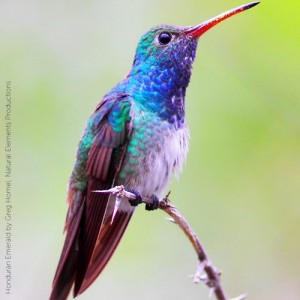
     The bird club in Catecamas and ASIDE work on sustainable community development issues, and conservation projects of importance to both neotropical migratory birds as well as resident species, like the Honduran Emerald. 


Photo of the only bird endemic to Honduras.  The Honduran Emerald occurs only in a few spots in Honduras, and nowhere else in the world.  Photo credit: Greg Homel, Natural Elements Productions.


Here is information quoted directly from the American Bird Conservancy website:


The Honduran Emerald
The Honduran Emerald is found only in the small Central American country of Honduras, where it is the country’s only endemic bird species. This, combined with its endangered status, makes it a high priority for us and our local partner ASIDE.
Part of the hummingbird population occurs in remnant tropical dry forest habitat in the Agalta Valley, where most of the habitat suitable for the hummingbird has been cleared for cattle grazing and other agricultural purposes such as fruit production.
     During the last 10 days of my time in Honduras, I will be participating in the Honduras Birding Tour for Conservation http://hondurasbirdtour.com/.  This tour will take me back to Lake Yojoa, to the area around the Copan Ruins (from the Mayan civilization) in western Honduras, and the north coast around Pico Bonito National Park, and finally finishing up back in San Pedro Sula.  I will be participating on a team led by Jeff Gordon, president of the American Birding Association and local Honduran bird guides to raise awareness among the birding community of the potential of Honduras as a birding destination.  This part of my trip will allow me to meet with members of birding clubs in La Ceiba (near Pico Bonito National Park) and in San Pedro Sula.

     Please consider helping to support this effort by making a contribution towards my in-country travel:  www.gofundme.com/2rha68nv.  Stay tuned for more information!


Thursday, September 22, 2016

Saving Migratory Birds by Establishing Links Between Sister Birding Clubs in North and Central America


     In another part of my life, I’m the president of the Cayuga Bird Club in Ithaca, NY.  Our club is interested in working with other clubs to establish a network of sister birding clubs at the northern and mid-southern (Central America) ends of the migratory flyway.  Populations of many of our Birds of Summer (many warblers, thrushes, vireos) are declining because of habitat loss on both breeding and wintering grounds.  At the same time, Central American endemics like Lovely Cotinga, Resplendent Quetzal, and Honduran Emerald are declining even faster because of their very specific habitat needs.  While bird conservationists are well aware of these dilemmas, many birders here and in Central America are less aware.

               For example, only about five years ago, the Honduran Ornithological Association (ASHO) started developing birding clubs in about a half-dozen locations throughout the country.  Just like birders here in North America, they enjoy watching birds.  However, they lack many basic resources like binoculars, field guides, access to places to bird, and access to local, Spanish-speaking birding trip leaders.  Further, little incentive exists in countries like Honduras to care about the impacts of habitat loss on birds because so few residents realize the importance of birds for the ecosystem services they provide (how many disease-carrying mosquitoes can a bird eat in a day?) and how they are indicators of how sustainable the local ecosystem is.  In part to bring more awareness to the birding opportunities in Honduras, and in part to raise funds for bird conservation there, the Honduran Tourism Bureau is sponsoring the first-of-its-kind Honduras Birding Tour for Conservation.  I have decided to participate in this event in November 2016. 

               I am going down to Honduras in mid-October to travel to as many of the six existing birding clubs in the country as possible to explore the idea of connecting with us as sister birding clubs.  Likely, this would mean starting out by connecting virtually through print and electronic media, skyping, and sharing pictures and stories.  Ultimately, we would like it to involve visits with our sister clubs.  The possibilities, and the benefits to birds and birders, are constrained only by our imaginations!
               Travel within Honduras to meet with the various clubs will take time and money for transportation, food, and lodging in the birding communities.  To make that part of my trip to Honduras possible, I have started a Go Fund Me campaign https://www.gofundme.com/2rha68nv. Please consider making a donation, and consider sharing this link with your members and other birding friends.