Sunday, November 17, 2013

Something a little different -- Saturday birding

     I did a little birding in my local area yesterday, and had a lot of fun.  This post won't have any models in it -- just a description of the experience.

          If you put a dot at the intersection of Freese and Hanshaw Roads northeast of Ithaca, and draw a circle of about a mile radius around it, you get the picture of where I was birding.  Besides encompassing my own residence, I like this circle because it includes patches of woods (some rather contiguous with others allowing for some substantial amount of forested habitat from early successional stages up to woods that might be have at least 60-70 years worth of growth).  It also has agricultural fields (corn and soybean in particular) that have recently been harvested and are attracting lots of waterfowl and loafing gulls.  It includes the Freese Road garden plots and similar grassy and old field habitats.  It also includes a section of Fall Creek, the little pond at Liddel Bee Lab and the wetlands at the Lab of Ornithology. 
          I set out Saturday about 9am with the express purpose of trying to see if the NELSON’S SPARROW was still hanging around the little pond by the bee lab on Freese Road.  It had been reported just the day before, so I thought there was a good chance that I might run into it if I was careful and persistent.  I have to admit that I did look for this bird with my sons the day that Tom first reported it (it is only a half mile from my house).  I thought my fledgling birder boys might enjoy trying to see a bird that they had never encountered before.  I am fairly certain that I got two glimpses of the bird with enough diagnostic field marks to say that I saw the bird that day, but the only looks my boys got were of a small brownish bird, twice jumping up out of the tall dead grass, flying about ten feet, and diving back into cover. 
          So, yesterday I headed straight to the pond area.  It is becoming fairly easy to see where others are looking for the bird because of the human foot prints in the mud and the little paths that are now meandering through the tall, dead grass.  I really didn’t want to put on a one-man drive through the grass in an attempt to flush the bird for a quick view.  So, I surveyed the area from a little distance and decided to walk in to the bank of the pond and sit against one of the bluebird/tree swallow boxes to see if I could hear or see this sparrow without flushing it. 

Plans vs. Reality


           Of course I ended up flushing birds just getting to the bluebird/tree swallow box.  One of these was a largish sparrow with a longish, more or less rounded tail, that seemed relatively dark on the top side (do you like my scientific descriptions?).  Perhaps a lingering SONG SPARROW.  

          Another bird was smaller, plumper, but not fat, and not interested in flushing nearly as far as the first bird (which went well over 40 yards before diving back into cover).  This second bird only would go about five to eight feet before hiding again.  This bird decidedly was not the Nelson’s sparrow, however, as I did see it well enough to know it had a very clean, unmarked throat and breast, and a mostly unmarked face, with a couple, broad brownish stripes on its head, and a light-colored bill.  The rational birder in me was saying to pay attention to the fact that it is mid November, and that this must be a juvenile White-crowned sparrow.  But the guy looking at the bird through 10x binoculars at about 12 feet, kept saying that this bird is way too small and simply not the right proportions.  Plus, the face, including the entire area around the eyes and auriculars was unmarked in my view of the bird.  This birder in me kept asking the question, why can’t this be a really late Field Sparrow?  American Tree Sparrow also jumped into the rational side of my brain, and the shape and size of this bird was much more similar to that than a White-crowned for sure.  Still, the bill was all one shade of light (not two-toned like the rational birder in me would expect with a Tree Sparrow), and I did have a decent, straight-on (albeit brief) view of the breast, and saw nothing that looked remotely like a breast spot.  

Un-requited Inquisitiveness


          The inquisitive aspect in me certainly was piqued with this bird, but certainly was not ”peaked.”  I like it when the level of inquisitiveness I experience increases above that magical minimum level that I need to feel both satisfied, and like I have demonstrated to myself that, yes, I am a birder.  Yet another "sparrow spp". in my notebook. 
            I flushed a third sparrow just getting to the place I wanted to sit down to watch.  This little lighter brownish job (LLBJ) also only went about 10 feet at grass-top level before diving back into cover.  I couldn’t really notice anything else about this bird at the time.  So, I sat down to watch and listen.

Relaxed and Observant 


          There was plenty to keep my attention.  Small flocks of blackbirds (mostly RED-WINGED BLACKBIRDS, with a few BROWN-HEADED COWBIRDS mixed in) were flying from north to south and then some coming back north again.  Over the almost square patch of woods to the west of this area, I saw a female AMERICAN KESTREL mobbing and rolling with a SHARP-SHINNED HAWK.  At different times, from one to four of the local AMERICAN CROWS would take offense to one of local RED-TAILED HAWKS perched nearby. 
          At one point about 15 twenty minutes into my sit, I heard a sharp, repeated call note approaching from above and behind me.  I turned around and found the bird in my binoculars.  It was fun to watch it come closer and ultimately land in a little bush just ten feet behind me.  This was without any doubt, a juvenile WHITE-CROWNED SPARROW.  I watched this bird in the bush for about a full minute until it flew to a different bush.  I feel like I got a good handle on its overall shape, and although it’s shape obviously changed as it altered it’s posture in the bush, it simply could not hide the fact that it is a relatively big, chunky, and longish sparrow.  This clearly was not the kind of sparrow as the second one I described above.

Like a Boy Scout -- Be prepared!


          At that point, I had not really seen or heard anything in the grass in front of me.  So, I decided to move on.  You can guess what happened.  I took just one step, and a sparrow flew up from in front of me, flew about seven feet, and landed on top of a little forb of some sort.  I got a really good look at it in profile for about 15 seconds.  A small compact sparrow, with a shortish tail.  Most striking was the orange wash on its breast, face, and even the undertones of its back feathers.  Substantial dark streaking on the orange breast, dark auriculars compared to the orange face, and thick stripes on its crown.  The last thing that seared into my brain before the bird jumped down into the thick over of dead grass was that its bill was decidedly un-sparrow-like.  It really reminded me of a meadowlark bill (and no, this was not a meadowlark!), sort of thick but long and pointed, not conical at all.  This really helped to accentuate a flat-headed appearance of the bird.  Think of a field sparrow or American tree sparrow with their rounded heads and little conical bills that come off of that round ball that is their head.  The NELSONS’S SPARROW has a really flat headed look, and then add this thick-based, but long, pointed bill to it and it gave a very different impression. 

Inquisitive and having a Sense of Discovery

          The inquisitive part of me was very satisfied with that observation.  Despite the fact that others found the bird and had reported it, I felt my own sense of discovery because I felt like I learned something new about a bird I had seen very, very infrequently before.  I walked on with a smile on my face.
          I was still relishing the experience only about 50 yards further on, when my subconscious mind started asking me what that BLUE JAY was squawking about.  I glanced to the north, and there only about 100 yards directly over my house (about a half mile away) I saw a huge, dark bird showing a slight dihedral as it soared/half glided into the south wind.  Even at a half mile it was clear that it was no turkey vulture.  The only question was which eagle it was. 
          The eagle closed the gap fairly quickly, and even flapped once or twice in the half mile between my house and where I was standing.  When I first put binoculars on it, I could see a lot of sunlight reflecting off the feathers on the top of the head of the GOLDEN EAGLE.  The bird ended up flying about 50 yards west of me and about 75 yards up.  I could clearly see a diffuse patching look to its underwing and undertail areas.  Not white patches as in a juvenile, but just the lighter patterns that occur still on older birds.  It’s flight feathers looked to me like a combination of a couple ages -- some brand new feathers and some older ones.  I think it likely was a second year bird although it is possible it was older. 
          When it passed at it’s closest it turned it’s head right toward me on the ground.  Through my binoculars, I almost felt like I could see my own reflection in the glint of it’s eye.  In his book “Birders: Tales of a Tribe,” author Mark Cocker writes about moments like this.  At least for some people, there is both the act of recognition (I know what the species is) and also an increasing sense of awareness and awe that you and this one bird have intersected while the bird is on an epic migration journey.  Cocker describes this as his sense of discovery.  It is as much about discovering something about yourself as it is in discovering the presence of a bird that isn’t common or abundant locally. 
          There are lots of different kinds of birds out there.  And, there are lots of different kinds of birders.  It’s fun discovering both kinds of diversity.
Jody Enck

Tuesday, January 15, 2013

    Birders and Duck Hunters on the Day of the Christmas Bird Count


      Recently, there has been quite a bit of discussion about duck hunters shooting in an area locally on Cayuga Lake that is a favorite of birders in the winter time because the area attracts a lot of waterfowl.  An added complicating factor is that it is near several public tracts of parkland.  Some folks in the birding community have suggested that an effort be made to create a no-hunting zone in the area of greatest waterfowl concentration.  These same people have said that they don't want to eliminate waterfowl hunting on the lake; they just want to stop it in their favorite birding location.  Could this really work?  Would birders and duck hunters both be happy with the situation?

Waterfowl on ice.  From Google images.

The short answer almost certainly is, 'NO'.

          The first challenge is that waterfowl don't use all parts of Cayuga Lake evenly or even randomly.  Cayuga Lake is huge.  It is about 41 miles long and 2-3 miles wide on average.  At it's deepest, it is more than 400 feet deep, meaning that much of it does not freeze in winter.  There are certain spots where they want to be, and other spots they rarely occur except to pass by infrequently. 

Why is this a problem?  Well, see the graphic below.


          Waterfowl hunters really need to be very close to the areas where the waterfowl want to be.  Their effective shooting distance is only about 50 yards (meters), and they prefer to shoot at waterfowl that are even closer than that.  Of course birders prefer to be close, too.  Watching bird behavior and interactions is really fun when the birds fill our field of view or camera viewfinder.  With just about any kind of optics, though, birders can be quite some distance away from birds and still enjoy seeing the crisp details of their plumage. 

           So, segmenting the area into hunting zones and birding zones probably would not be very practical.  This raises another question: why can't birders and hunters tolerate each other enough to actually focus on things that are important to both -- namely, bird conservation issues and habitat protection?  This idea will be the topic of another post.

          Go bird!  And don't forget to buy a federal "duck stamp" formally known as a migratory bird hunting and conservation stamp.  To learn more about the federal duck stamp program, go here:  www.fws.gov/duckstamps/


Wednesday, October 3, 2012

Why distinguish between Being a Birder and Going Birding?

     Some people have questioned whether it is meaningful to separate the development of one’s self-perception as a birder from the activity of going birding.  I contend that it is not only meaningful, but necessary, if one is truly interested in the notion of recruiting and retaining birders.  Here is why I think that.
     In 1979, a Mississippi business man named James Vardaman traveled over 160,000 miles (by plane, car, boat, bicycle, and on foot) and recorded seeing 699 species of birds in the U.S. and Canada.  His adventures were chronicled in the book “Call collect: ask for birdman.”  He spent tens of thousands of dollars on his quest and was accompanied by “experts” all along the way who mostly identified the species for him and provided their signed attestations that each species was indeed seen by Vardaman.  Now, Mr. Vardaman certainly could identify many species on his own, but even he claimed that he wasn’t really a birder. 
     So, here is someone who spent hundreds of days and a ton of money in a given year looking for birds.  He accumulated a huge total number of species seen.  Yet, he claimed not to be a birder, and many people in the birding community agreed with him!  Some people said he simply “bought” the long list of species rather than “earning” it.  In other words, these people were saying that Mr. Vardaman exhibited many birding-related behaviors, but lacked some (most?) of the important characteristic traits associated with being a birder.  He went birding, but he was not a birder.
     Anybody with sufficient time, money, and access to experts who can identify species for them, can overcome some of the big challenges faced by Apprentices who are trying to become birders.  Namely, they can by-pass the frustration that comes from encountering a high proportion of birds that they simply do not know  how to identify (which can keep them “stuck in beginner mode), and they can by-pass the sense of being overwhelmed at all the diversity of bird types they encounter (see Figure 1).  Note in the figure below that Apprentice Birders eventually overcome these possible identity-destroying traits (being frustrated, being overwhelmed by diversity) by developing identification skill and expertise.  Even more importantly, notice in the model that frustration and the sense of being overwhelmed do not even occur as two identity-defining traits increase: (1) confidence as a birder and (2) being observant. 
Figure 1.  Red boxes indicate two possible identity-destoying traits that can cause Apprentice Birders to quit birding while green boxes indicate to possible identity-defining traits that Apprentices develop over time on their way to becominig Recruited Birders.
     My point is that becoming a birder is very different from going birding and accumulating large life lists.  Becoming a birder cannot be achieved by taking short cuts.  Obviously, having a good birding mentor can speed-up the process and can help reduce frustration and sense of being overwhelmed that can arise for Apprentice Birders.  But, becoming a birder still takes time, and hopefully, a lot of fun as the Apprentice develops the various characteristic traits of being a birder.
Go bird!

Monday, September 24, 2012

Why do some Apprentice Birders loose interest in posting their lists of sightings?

          Many relatively new birders -- those who are essentially trying-out an identity as a birder (i.e., Apprentice Birders) -- start out with quite a zeal for posting their sightings of birds on listserves and other places.  And why not?  Their interest has not only been piqued, it has been fired up.  They are learning to identify birds that many of their friends may not know how to identify and they want to feel like they are an integral part of their new-found birding culture. 

Will these observers post their bird sightings?
          We all get a lot of vicarious enjoyment from folks who post their sightings for all the world to see.  I know that I like to know what others are seeing around the local area, and love some of the wonderful anecdotes that folks share along with their sightings.  A lot of these new (Apprentice) birders post sightings feverishly for awhile and then stop.  Why is that?  Do they get tired of reporting the same sightings over and over?  Do they stop going birding?  If they stop reporting their sightings of common birds, will they still report uncommon birds that other folks might want to go and see?  In this blog post, I model a few hypotheses about this kind of behavior by Apprentice Birders.  Some of these hypotheses may have ramifications for birder recruitment and retention efforts.

          First, I want to discuss the question of why any birders (Apprentices or full-fledged Recruited Birders) report any sightings anyway.  In other words, what motivates a birder to report sightings?  Social science research suggests that different people may have different motivations for the same behavior, and even one person  may have different motivations from  time to time (although one motivation is usually is more dominant than others).  Some of these different motivations may be: (a) to fulfill a desire to share information with others, (b) to maintain a sense of belonging to birding community, or (c) to let folks know that you're out there looking for, and seeing, birds (i.e., searching for some degree of prestige although nobody would admit to calling it that).  As a corollary, people may be motivated to report sightings of rare birds either (a) to fulfill a desire to share information with others, (b) to earn credibility among their birding peers, or (c) to stake a first claim to having found a rare bird (i.e., prevent "poaching" of discovered birds).  Hypotheses can fairly easily be developed about any of these different motivations. 

          Because I want to focus on Apprentice Birders in this blog post, I will limit my models to motivations pertaining to (a) fulfill a desire to share information with others, and (b) maintaining a sense of belonging to the birding community.  Both of these motivations (desire to share and desire to feel connected) can be thought of as identity-defining, characteristic traits for some birders.  As such, both can be depicted in models as "stocks" (see main page about how to read the components of models) that can increase or decrease depending on certain factors (Figure 1).  
Figure 1.  Two possible identity-defining, characteristic traits depicted as stocks that can increase or decrease depending on various factors.

          If these are indeed, identity-defining traits of some Apprentice Birders, increasing or maintaining the levels of these stocks would be important motivators for Apprentices to report their sightings of birds -- if those Apprentices linked in their minds (1) reporting birds and (2) increases in one or both of these traits.  In a model, it might look something like what you see below (Figure 2).
Figure 2.  Reporting bird sightings can help Apprentice Birders feel more connected to the birding community, especially when those sightings are confirmed by others and those other birders thank the Apprentices for reporting the birds.

          In the figure above, I only show "sense of belonging" just to save space.  I think that trying to increase one's sense of belonging to a desirable group can be a major motivation for behavior.   Similarly, trying to increase or maintain some minimum desirable level of "being a sharer" also likely is a major motivation for reporting behavior.  However, reporting bird sightings can be a real 2-edged sword, especially for Apprentice Birders whose excitement level may exceed their level of skill at the finer points of bird identification.  Sometimes, Apprentice Birders make mistakes.  Every birder does, even the supposed experts.  If someone identifies a fall Blackburnian Warbler as an out-of-range Yellow-throated Warbler, it really is no big deal.  A few folks may spend gas money and time away from family or work to try to see the more rare species, but the world is not going to end, and they may stumble upons some other interesting birds.

          Still, if Apprentice Birders are reporting their sightings in an effort to feel more connected to the birding community, any public notification that they made an identification error -- no matter how tactfully the notification is done -- will depress that sense of being connectied.  Further, if the erroneous sighting is corrected in some untactful way, it could lead to an intolerable level of "ridicule."  In this case (Figure 3), "ridicule" could be an identity-destroying characteristic.  Loss of a "sense of connection" to the birding community is likely to lead to the Apprenitice stopping reporting (because erroneous reporting is draining away that sense of connection).  If the Apprentice's feeling of ridicule gets too high, he is likely to actually stop trying to develop his identity as a birder. 
Figure 3.  Apprentice Birders may be motivated to report their bird sightings to increase their sense of being connected to the birding community, but hearing that they have may an erroneous identification can decrease that sense of connection, and untactful notifcation of their error can lead to intolerable levels of an identity-destroying trait like "ridicule."
           Moral of the model is to take it easy on Apprentice Birders and thank them for sharing their sightings whether or not they made an identification mistake.

          Go bird!


Friday, September 21, 2012

Having fun with models: understanding the Patagonia Picnic Table Effect


     Ever hear of the Patagonia Picnic Table Effect?  It's named for the concrete picnic table at the roadside rest along the 2-lane highway near Patagonia, Arizona.  
Rose-throated Beccard


The story goes that somebody found some "good" birds there when they got out of their car to take a break.  Perhaps those "good" birds were some Rose-throated Beccards that nested there for a few years, or maybe a Tropical Kingbird, or some other denizen from south of the Mexican border. 
 

Anyway, the discoverer duly reported the find.  Soon other birders came to see that rarity, and found other "good" birds, like Blue Mockingbird, Rufous-capped Warbler, and others.  These birds were also reported to Rare Bird alerts, more birders came to the rest stop, and  found more rarities.  These were reported, thus attracting even more birders, and so on.  This kind of scenario obviously has occurred in lots of other places.  Indeed, almost any "hot spot" has become a "hot spot" because of this Effect.  
Blue Mockingbird

     I am not sure who was the first to name this scenario the Patagonia Picnic Table Effect, but many writers have referred to it by this name.  As a modeler, I like to think that models can be used to help us understand real life, and the Patagonia Picnic Table Effect provides a good example to try to model just for fun.  See, not every model has to be used to discover some unknown piece of the bigger puzzle or to test hypotheses.  Models can be just for fun!

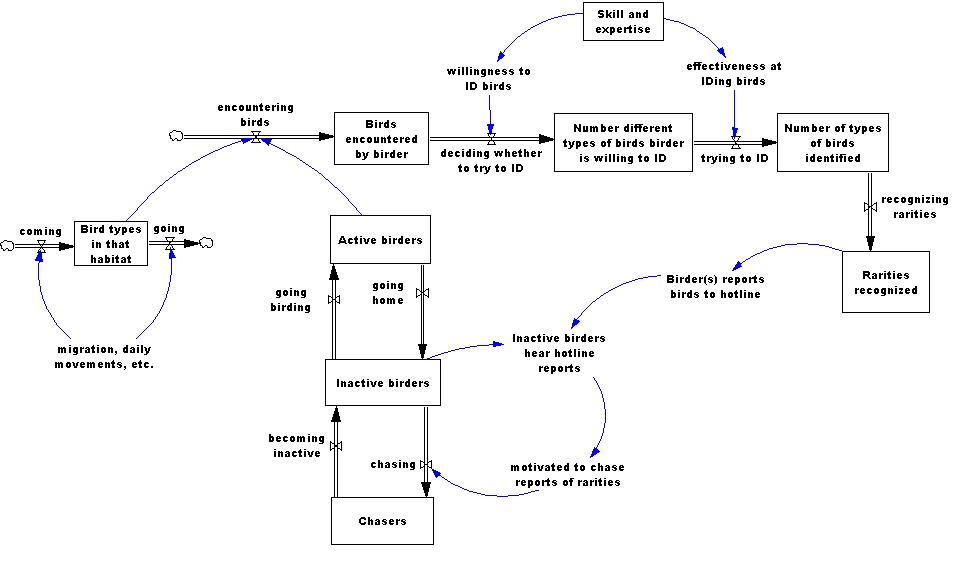
     So, what would a model of the Patagonia Picnic Table Effect look like?  Like many other models of birders' behavior in the field, this model starts out with some basic Bird-Birder interactions like encountering birds, deciding whether to try to identify them, and ultimately working out some of the identifications.  The addition to the basic model in this case is that at least one of the identified birds is recognized by the birder as a "rarity" (Figure 1).
 
Figure 1.  Basic Bird-Birder interactions leading to the identification and recognition of some "rarity" worthy of being reported to a local hotline.
 
     When the birder recognizes a rare or unusual species, she decides not to keep the sighting to herself, but reports it to a Rare Bird Alert or some other birding hotline.  Birders who were dutifully at work or having a second cup of coffee at home or otherwise "inactive" (i.e., not in the field birding) get these reports, and that is when all heck breaks loose.  If the reported bird is really unusual for that location, it motivates these inactive birders to go "chase" the bird (i.e., to chase the report of the bird, actually).  In this model, I am calling folks who hear these reports and decide to go try to see the rarity "chasers" to distinguish them from "active birders" who initially find and report these birds (Figure 2).

Figure 2.  Inactive birders hear reports of rare birds and are motivated to become "chasers" of those reports.
     As these "chasers" show up and (hopefully) relocate the rare bird, their searching can turn up other "good" birds.  These also get reported to the hotlines, bringing even more "chasers" to the scene who find even more "good" birds, and so on.  This last figure (3) shows the full Patagonia Picnic Table Effect.


Figure 3.  Full model of the Patagonia Picnic Table Effect.
     I hope that this blog post has shown that models can be developed to show experiences that occur in real life, including situations that have been immortalized in the birding literature with their own names.  See models can be fun, can't they?

Go bird!

Monday, September 17, 2012

Hypothesis 1 for Apprentice Birders: the cycle of building and releasing frustration keeps some Apprentice Birders stuck in "beginner mode"

Recall the basic bird-birder interactions that form the foundation for understanding the behavior of birders in the field.  To summarize the model (Figure 1), the Apprentice Birder encounters birds.  He focuses on one particular bird, and decides whether to try to identify it.  Unfortunately, the observed bird looks like many similar ones in the bird book.  That’s Ok, he’ll just look for another to that might be easier to identify.  But, the next one is too hard to identity.  And so is the third one, and the fourth one. 
Figure 1.  Basic bird-birder interactions.
Each time this happens, a little a little more frustration builds for the Apprentice Birder (note the red box in Figure 2).  In an effort to release that building frustration, the Apprentice Birder looks for another, easier-to-identify bird.  Easier-to-identify birds might be birds the Apprentice already knows, or they might be birds that look just like a picture in a book.

Figure 2.  Some Apprentice Birders become frustrated by encountering birds that are "too hard" for them to even try to identify and so go look for easier birds to identify.  By always looking for birds to identify that are not "too hard," they never improve their identification skills.  The result is that they get stuck in "beginner mode."
Either way, the Apprentice’s level of skill in identifying birds does not improve.  (Note in the model that no flow pipes come into or out of the variable called “skill and expertise” indicating that the level remains constant.)  Because a high percentage of encountered birds always will be “too difficult” for the Apprentice to even try to identify, the level of frustration always will exceed some tolerable level.  Consciously or unconsciously, the Apprentice Birder will seek to release that frustration.  The easiest way to do that is for the Apprentice to look for another bird to try to identify. 
An important key for getting “unstuck from beginner mode” is for the Apprentice Birder to improve his or her bird identification skills.  There may be many good ways to do this (and some ways that are not so good).  Future blogs will address some hypotheses about various ways.

Go bird!

For Whom Do You Cheer

Ever see a Peregrine Falcon swoop low across the mud flats and scare a flock of shorebirds into flight?  More often than not when I have seen this behavior in the company of birding friends, the others cheer when the Peregrine comes up empty.  Not me. 
I am no sadist.  I do not revel at horror movies.  I have no relatives who are vampires.  I simply appreciate the equations of nature dealing with energy intake and survival.  Namely, things have to eat to survive.  A Peregrine Falcon’s food sources include shorebirds. 

      After all, shorebirds eat, especially lots of invertebrates.  Who cheers for the worms that got away?  Who cheers for the mosquito larvae that wiggled out of the grasp of a Least Sandpiper?  I know what you’re thinking: worms and mosquitos – eewwww.   It doesn’t matter.  Live things are alive because other things used to be, but aren’t any more. 
I’m not sure if it’s something about wanting the underdog to win or an aversion to death, but lots to people seem to cheer for prey when predators are around.  In the philosophical treatise on birding “Life in the Sky with Wings,” author Jonathan Rosen substantiates this preference for prey eluding predators.  On page 144, Rosen describes accompanying a falconer who uses a pair of Harris’ Hawks to capture partridges:
…the partridge was in the shadow when I finally noticed it.  The bird was beautifully marked with black shadow lines – the whole bird looked like a painted face.  The hawks were both ten feet or so up, but they had not yet noticed the partridge.  The partridge, however, was aware of the hawks, and seemed frozen with fear I felt I could reach out and pick the bird up with my bare hands… Standing with the petrified bird at my feet and the dark raptors above, I felt not the murderous rapture I had hoped to experience in some perverse way, but a kind of bored impatience and a bit of shame.  This was not what I wanted.  My sympathy was with the partridge.
                My sympathy lies with the predator.  Watching the death part of the circle of life and death helps me feel connected to nature in all its fullness.  When a raptor stoops on avian prey, but misses, the circle of life and death is not a closed loop.  It’s like an open electrical circuit, and the current of life cannot proceed. 

               I guess cheering for either the predator or the prey is a little weird anyway.  Despite the fact that I firmly believe humans are an integral part of nature, the notion of cheering for either the falcon or the shorebird seems like I am wishing I could truly be a part of nature, but feeling at that moment like I am relegated to standing on the sidelines.
                Next time you see a Peregrine Falcon swoop across a mud flat filled with shorebirds, for whom will you cheer?
         Go bird!