Showing posts with label models. Show all posts

Friday, September 21, 2012

Having fun with models: understanding the Patagonia Picnic Table Effect


     Ever hear of the Patagonia Picnic Table Effect?  It's named for the concrete picnic table at the roadside rest along the 2-lane highway near Patagonia, Arizona.  
Rose-throated Beccard


The story goes that somebody found some "good" birds there when they got out of their car to take a break.  Perhaps those "good" birds were some Rose-throated Beccards that nested there for a few years, or maybe a Tropical Kingbird, or some other denizen from south of the Mexican border. 
 

Anyway, the discoverer duly reported the find.  Soon other birders came to see that rarity, and found other "good" birds, like Blue Mockingbird, Rufous-capped Warbler, and others.  These birds were also reported to Rare Bird alerts, more birders came to the rest stop, and  found more rarities.  These were reported, thus attracting even more birders, and so on.  This kind of scenario obviously has occurred in lots of other places.  Indeed, almost any "hot spot" has become a "hot spot" because of this Effect.  
Blue Mockingbird

     I am not sure who was the first to name this scenario the Patagonia Picnic Table Effect, but many writers have referred to it by this name.  As a modeler, I like to think that models can be used to help us understand real life, and the Patagonia Picnic Table Effect provides a good example to try to model just for fun.  See, not every model has to be used to discover some unknown piece of the bigger puzzle or to test hypotheses.  Models can be just for fun!

     So, what would a model of the Patagonia Picnic Table Effect look like?  Like many other models of birders' behavior in the field, this model starts out with some basic Bird-Birder interactions like encountering birds, deciding whether to try to identify them, and ultimately working out some of the identifications.  The addition to the basic model in this case is that at least one of the identified birds is recognized by the birder as a "rarity" (Figure 1).
 
Figure 1.  Basic Bird-Birder interactions leading to the identification and recognition of some "rarity" worthy of being reported to a local hotline.
 
     When the birder recognizes a rare or unusual species, she decides not to keep the sighting to herself, but reports it to a Rare Bird Alert or some other birding hotline.  Birders who were dutifully at work or having a second cup of coffee at home or otherwise "inactive" (i.e., not in the field birding) get these reports, and that is when all heck breaks loose.  If the reported bird is really unusual for that location, it motivates these inactive birders to go "chase" the bird (i.e., to chase the report of the bird, actually).  In this model, I am calling folks who hear these reports and decide to go try to see the rarity "chasers" to distinguish them from "active birders" who initially find and report these birds (Figure 2).
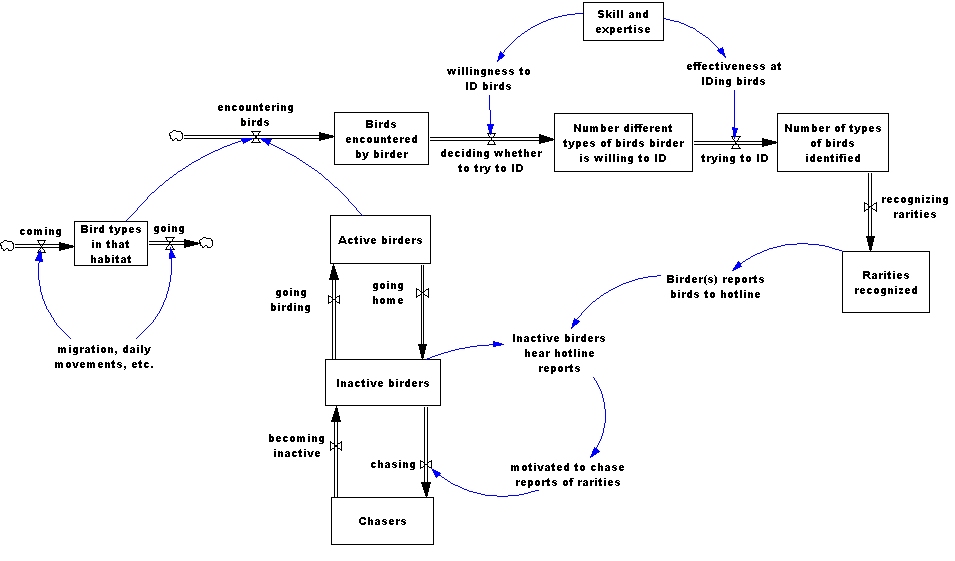
Figure 2.  Inactive birders hear reports of rare birds and are motivated to become "chasers" of those reports.
     As these "chasers" show up and (hopefully) relocate the rare bird, their searching can turn up other "good" birds.  These also get reported to the hotlines, bringing even more "chasers" to the scene who find even more "good" birds, and so on.  This last figure (3) shows the full Patagonia Picnic Table Effect.


Figure 3.  Full model of the Patagonia Picnic Table Effect.
     I hope that this blog post has shown that models can be developed to show experiences that occur in real life, including situations that have been immortalized in the birding literature with their own names.  See models can be fun, can't they?

Go bird!

Monday, September 17, 2012

Hypothesis 1 for Apprentice Birders: the cycle of building and releasing frustration keeps some Apprentice Birders stuck in "beginner mode"

Recall the basic bird-birder interactions that form the foundation for understanding the behavior of birders in the field.  To summarize the model (Figure 1), the Apprentice Birder encounters birds.  He focuses on one particular bird, and decides whether to try to identify it.  Unfortunately, the observed bird looks like many similar ones in the bird book.  That’s Ok, he’ll just look for another to that might be easier to identify.  But, the next one is too hard to identity.  And so is the third one, and the fourth one. 
Figure 1.  Basic bird-birder interactions.
Each time this happens, a little a little more frustration builds for the Apprentice Birder (note the red box in Figure 2).  In an effort to release that building frustration, the Apprentice Birder looks for another, easier-to-identify bird.  Easier-to-identify birds might be birds the Apprentice already knows, or they might be birds that look just like a picture in a book.

Figure 2.  Some Apprentice Birders become frustrated by encountering birds that are "too hard" for them to even try to identify and so go look for easier birds to identify.  By always looking for birds to identify that are not "too hard," they never improve their identification skills.  The result is that they get stuck in "beginner mode."
Either way, the Apprentice’s level of skill in identifying birds does not improve.  (Note in the model that no flow pipes come into or out of the variable called “skill and expertise” indicating that the level remains constant.)  Because a high percentage of encountered birds always will be “too difficult” for the Apprentice to even try to identify, the level of frustration always will exceed some tolerable level.  Consciously or unconsciously, the Apprentice Birder will seek to release that frustration.  The easiest way to do that is for the Apprentice to look for another bird to try to identify. 
An important key for getting “unstuck from beginner mode” is for the Apprentice Birder to improve his or her bird identification skills.  There may be many good ways to do this (and some ways that are not so good).  Future blogs will address some hypotheses about various ways.

Go bird!

Thursday, September 6, 2012

Modeling basic bird-birder interactions

The cast of characters: Birds and Birders

Here is a simple model showing basic interactions between birds and birders in some local patch.  First, birds come and birds go in the patch.  Their coming and going is affected by things like migration and daily movements in search of food and cover, among other things.
Figure 1.  Birds come and birds go in a local patch.
Now suppose some birder (maybe you?) are busy at home or are doing something other than birding.  In other words, you are an inactive birder.  At some point you are motivated to go birding.  When you are done birding and go home, the active birder becomes an inactive birder again.


Figure 2.  Inactive birders become active birders when acting on their motivations to go birding.

Basic Bird-Birder interactions: (1) encountering different kinds of birds

     There is a basic pattern to all bird-birder interactions.  First, the birder encounters birds (i.e.,  sees or hears birds).  This encounter might be with a single bird or a whole bunch of birds.  During the time the birder spends in the patch, she will probably encounter lots of different kinds of birds.  The important part that makes this model useful for all birders (from beginners to experts) is that "different kinds" does  not mean "different species" in this model.  Rather, it means birds that look different to the birder.


Figure 3.  When an active birder goes birding, she encounters a number of birds that look or sound different from each other.

A second basic Bird-Birder interaction: (2) deciding whether to try to identify an encountered bird

     Some birders try to identify every single bird they encounter.  However, especially when folks are just starting out learning about birding, they simply do not have the knowledge base to do this.  They ignore lots of birds that are too difficult for them to even try to identify (e.g., think streaky sparrows, gulls, shorebirds, etc.).  These folks will decide to try to identify only a small percentage of the different kinds of birds they encounter.  For the sake of this model I am creating, I will refer to the percentage of birds that the birder decides to try to identify as an index to the birder's willingness to identify an encountered bird.  This willingness can be affected by lots of things like how good the view of the bird is, various distractions, etc., but the greatest influencing factor (at least in this model) is the birder's skill level.


Figure 4.  A birder tries to identify only a percentage of encountered birds; "willingness to identify" is an index to this percentage.

A final basic Bird-Birder interaction: (3) trying to work out the identification of an encountered bird

     So, a birder will decide (i.e., be willing) to try to identify only a small percentage of encountered birds while birding.  Similarly, he will be able to put a name on only a percentage of birds he tries to identify.  Here, I refer to this percentage as an index to his "effectiveness at identifying" birds.  Think of it this way: I tried to identify 10 birds, but could only put a name on 7.  In this case, the effectiveness is 70%. 

     By taking the number of different kinds of birds encountered by the birder and multiplying by her willingness to identify birds, one can "calculate" the number of types the birder is willing to try to identify.  Then by multiplying this by her effectiveness at identifying birds, you can "calculate" the total number identified.  Essentially, the last box in the model is the number of types on n the list of  birds tallied by the birder while birding.


Figure 5.  The complete model of basic bird-birder interactions, including encounters with birds, willingness to try to identify encountered birds, and effectiveness at identifying them.

     This basic model will form the basis of many, many subsequent posts about the birding behavior of birders.

Go bird!