Showing posts with label neotropical migratory birds. Show all posts

Wednesday, November 23, 2016

What Good is a Sister (Bird Club)? - Re-learning Everything You Thought You Knew About Bird Behavior

          Those of us who grew up with sisters know that they are smart -- really smart.  Even if you think you know a lot, you can always learn something from your sisters.  I know this is true because my two brothers and I have five sisters.  Growing up, we boys had to learn, re-learn, and re-re-learn things over and over again -- mostly things like not taking advantage of their fear of snakes or not forgetting their propensity to stab first and ask "who's there" later.  All kidding aside, I am still learning so much from my sisters, and I hope to for a long, long time to come.

          I think the same can be true for the idea of sister bird clubs.  I recently returned from an extended visit to Honduras where I was exploring the idea of establishing sister bird clubs between the U.S. and that Central American country.  When I came back, some of my birder friends asked, "what good is it to develop a network of sister bird clubs?" I think the simple answer is that we can learn a lot from each other about the birds we think we know pretty well, but maybe don't know as much as we think we do.

          Consider the Neotropical migratory birds that we northerners wait all winter to see in spring.  When migration starts, we don't just go looking for these birds in random places.  We know where to look for them because we know their habitat preferences and their behaviors.  Want to find migrating Bay-breasted Warblers or
Look in the forest canopy if you want to find one of
these Bay-breasted Warbler in breeding plumage
during spring migration.  Photo credit: Bill Majoros.
Black-throated Green Warblers in central New York?  Check out the forest canopy.  Looking for Common Yellowthroats or Gray Catbirds?  Head to brushy areas and edge habitats.  What about Golden-winged or Blue-winged Warblers?  Early-successional habitats and brushy habitats are the places to look. 

          Most of these birds are fairly specific in their habitat use and foraging behaviors when migrating through our area and when staking out breeding territories.  The authoritative website All About Birds hosted by the Cornell Lab of Ornithology provides useful summary icons to help birders know what habitats to look in (e.g., forest, scrub) and foraging habits to look for (e.g., foliage gleaner, ground forager) to help searching birders encounter specific birds.     

          Indeed, at the northern end of the migratory pathways, these Neotropical migrants are such creatures of habit that one can generalize about the particular part of a tree in which they are mostly likely to be found!  In an article in the summer 2016 issue of Living Bird magazine (also produced by the Cornell Lab of Ornithology), distinguished ornithologist Irby Lovette penned an article about how a young graduate student named Robert MacArthur discovered in the 1950s that some warblers nesting in the spruce forests of Maine partitioned individual spruce trees as a way of dealing with stiff competition from other species with similar food requirements and foraging strategies.  Dr. Lovette wrote that nearly 70 years later, another young graduate student found that some of the species of bird had changed from the 1950s, but that birds still generally spent most of their time foraging in particular parts of trees.  You can read about that on Cornell Lab of Ornithology website. 
 
Drawing from the summer issue of the Cornell Lab of
Ornithology's Living Bird magazine showing how
some warbler species generally forage in certain parts
of spruce trees to reduce inter-specific competition.
Drawing was done by: Deborah Kaspari.
         Bay-breasted and Black-throated Green Warblers are mentioned in that article as two of these tree-partitioning species.  In general, these two species tend to forage much lower in the branches of spruce trees than Yellow-rumped or Blackburnian Warblers (mid-tree foragers) or Cape May Warblers (tree-top foragers).  Knowledge of such specific behavior can be especially useful for birders who may only get partial glimpses of quickly moving birds trying to gorge themselves on insects.

          What does any of this have to do with sister bird clubs?  Well, like any smart sister, our sister bird clubs in Honduras could help us learn that almost none of this specificity applies to habitat use or foraging habits of these very same species in Central America.  I had this lesson driven home time and time again on my trip to Honduras.  Yeah, everything I thought I knew about the behavior of these birds that could help me locate and identify these species had to be re-calibrated on the migration and wintering grounds. 

          I'll never forget the rapid-fire birding late on the fourth day of competition during the Honduras Birding for Conservation Tour.  Our team of 10 birders, which we named The Ant Swarm, was led by Jeff Gordon, president of the American Birding Association, and Esdras Lopez, a highly-skilled, Honduran bird guide.  We had just returned via a several-hour bus ride from the dry Aguan Valley to the north coast after successfully tallying dry forest species such as the endemic Honduran Emerald, Lesser Roadrunner, White-bellied Wren, and Lesser Ground-Cuckoo.  In La Ceiba, we were birding around some sewage lagoons close by where the Cangrejal River empties into the Caribbean Sea. 

          After spending hours on a bus, we were in serious need of adding more bird species to our tally during the fading hour of daylight.  Between the lagoons and a few small houses of some
Members of The Ant Swarm birding along waste water lagoons
in La Ceiba, Honduras.  Does this look like Bay-breasted
Warbler habitat?  We found them feeding on the ground here.
Photo caption: Jody Enck.
local residents was an open, dirt-and-grass area backed by some brushy habitat.  We found a number of species using this general area.  Some birds were on the ground.  Members of The Ant Swarm sorted through the birds and called out the species.  I recall seeing a Bay-breasted warbler in that dirt-and-grass area, and calling out its name.  "No way!" barked Jeff Gordon.  "I've never seen a Bay-breasted Warbler foraging on the ground."  But, there it was in all its glory acting more like a sparrow than a forest warbler.  We found numerous other individuals on the open ground during the Tour, too.

          Oh, but we also found them deep in the forest.  Early in my travels in Honduras, I was fortunate enough to spend a couple days on the north coast at the Lodge and Spa at Pico Bonito.  The lodge property abuts the largely inaccessible Pico Bonito National Park. 
Another habitat where we found Bay-breasted
Warblers, this time feeding high in the canopy.
Photo credit: Jody Enck.  
One morning, Katinka Domen from Beaks and Peaks Birding and Adventure Tours and I trekked off in the dark for an hour of hiking uphill just so we could access a sort-of trail into the National Park at daylight.  As we hiked our way through an amazingly pristine Rainforest on the lower slopes of the namesake mountain, we came across a number of deep-forest species.  These included Plain Antvireo, Tawny-crowned Greenlet, Nightingale Wren, and Ruddy-tailed Flycatcher.  We also repeated saw these birds that for all the world acted like some deep-woods Oriole, gleaning for insects high in the canopy of Rainforest.  You guessed it -- Bay-breasted Warblers were really quite common in the deep Rainforest.

          This very idea was raised by birders from a couple of the bird clubs with whom I met in Honduras.  Their experiences with Neotropical migratory birds as well as resident Central American species let them to realize that these species seem to use habitat differently and that their foraging habitats likely differ as well.  The Honduran birders pointed out that they would like to know more from us about habitat use and behaviors of migrant birds when they are here on their breeding grounds, and that they could help us learn more about habitat use and behaviors of those birds on their wintering grounds.

          Sharing information about the bird species we share is a great idea.  It goes well beyond just helping birders know where to look for these species, however.  A big part of what we can learn from our sister bird clubs has to do with long-term conservation of bird species. 

Non-breeding plumaged Bay-breasted Warbler.  When foraging
high in the canopy of the Rainforest, these relatively large
warblers can be confused with female or immature orioles.
Photo Credit: Jame Hurt.
          Data from the Canadian breeding grounds for both Bay-breasted Warbler and Black-throated Green Warbler show that these species have been experiencing slow, but long-term declines in population size.  Habitat loss on breeding grounds, along migration routes, and on wintering grounds is a key factor influencing population trends for both species.  Consider, however, that these species seem to be able to use a great variety of habitat types during migration and on their wintering grounds than some of the more habitat-specific resident birds in Central and South America. 

          Loss of habitat for those resident species has an even great
In the buffer zone of Santa Barbara National Park, Honduras,
clearing for small-scale agriculture negatively impacts habitat
availability for birds.  Photo Credit: Jody Enck.
impact because they are unable to utilize as wide of a range of habitats.  I witnessed loss of forest habitat on a frequent basis when I was in Honduras.  Each day, more forest was lost to wood cutting and clearing for agriculture.  Loss of mature forest is having a devastating effect on populations of resident birds in Central America.

          Even week-to-week changes in habitat structure in areas cleared for agriculture affect distribution, and ultimately, abundance of Neotropical migratory species.  In mid-October, I
A farmer using a machete to cut weeds and remnants of
agricultural plants to prepare the hillside for the next crop.
Even small-scale farmers can have large-scale impacts on
habitat for both resident and Neotropical migratory birds.
Photo Credit: Jody Enck.
observed many species of Neotropical migratory species and some resident birds that utilize weedy and early-successional woody habitats in areas where small-scale farmers recently had harvested corn and other crops.  When I was back in the same area four weeks later, agricultural habitats where I had encountered Mourning and McGillivray's Warblers, Variable Seedeater, Prevost's Ground-Sparrow, Green-throated Mountain-Gem, and Rufous-capped Warbler had been hacked to the ground in preparation for planting a new crop of corn and beans. 

          These are the kinds of things that our sister bird clubs can help us learn: habitat use and habits of birds with which we are familiar in North America are not the same farther south in migration or on the wintering grounds.  Habitat types and short-term changes to those habitats are not the same as what we are used to in North America.  At the very least, our sister bird clubs can share these stories, pictures, videos, and bird population information with us to help us re-learn what we might have thought that we know.  We also might engage in exchange visits to learn some of these things firsthand. 

          Yes, our sister bird clubs can help us learn and re-learn a lot.  Gaining that kind of knowledge is important.  Even more important is connecting the dots between the various pieces of knowledge to increase our understanding about the world around us, especially the conservation implications.  Most important then will be to work with our sister bird clubs to use that understanding to achieve conservation outcomes for the birds we share and that we love so much.


Friday, November 18, 2016

Honduras by the numbers -- Part I

          Readers of this blog will know that I just returned from almost five weeks in Honduras.  One of my main reasons for going was to meet with bird clubs there to explore the idea of developing a network of sister bird clubs between North America and Central America.  That part of my trip was a rousing success as I have reported previously. 
A reunion of sorts took place on 6 November at Pico Bonito
Lodge.  Two of my new friends from bird clubs in Honduras,
Hector Moncada (on left, from San Pedro Sula) and
Francisco Rovelo (on right, from Gracias), were there
participating in an education workshop put on by BirdSlueth
International (from Cornell University) and I was participating
in the Honduras Birding for Conservation Tour.
Photo Credit: Jody Enck.
          The two other successful aspects of my trip were to participate in the Lake Yojoa Birding Blitz in mid October and to also participate in the Honduras Birding for Conservation Tour during the first half of November.  If making a couple dozen new friends and seeing hundreds of species of birds equals success, then I had the grandest of successful times!

          Upon reading some of my earlier blog posts in late October, one of my new friends from Zamorano University noticed that I wrote a lot more about the people I was meeting and experiences I was having than about the birds I was seeing.  This post is to "correct" that deficiency.  All the bird species in photos below are species that I saw.

          One can find about 765 species of birds in Honduras assuming you have the time and wherewithal to scour every corner of this geographically and ecologically diverse country and have lots on luck on your side.  One of these bird species, a beautiful

little hummingbird called the Honduran Emerald, is found nowhere
Honduras' only endemic bird species: the Honduran Emerald.
Photo Credit: Beaks and Peaks Adventure and Birding Tours.
else on Earth except in Honduras.  Another 75 of so species are resident rainforest birds that you can find only in the largely inaccessible eastern reaches of Honduras called Mosquitia -- or farther south in Central America.  Of the 765 bird species one can encounter in Honduras, only about 140 or so (excluding seabirds) are our North American "Birds of Summer" -- Neotropical migratory birds that breed up in North America and winter in, or migrate through, Honduras.


          According to my records, I ended up seeing/hearing 387 species of birds in Honduras -- almost exactly half of the birds that occur in the entire country.  Of these, 174 were Life Birds for me.  (For non-birders, a Life Bird is a species that you have never seen/heard before in your life).  This means that about 45% of the species I encountered in Honduras were completely new to me.  That's a great trip!

          Below is a breakdown of what I encountered.  These numbers are not exact (in terms of the numbers of migrants vs. resident birds, etc.).  I provide approximations just to give you a sense of what I encountered.

Tinamous
4 species occur in Honduras.  
Great Tinamou for those of you who don't know what
a Tinamou is.  Photo Credit: Wikipedia.  
All species are residents (not Neotropical migrants).  I saw/heard 2 of the 4 species, and both were Life Birds for me. 


Ducks and Geese
About 15 species occur in Honduras, and 8 or so of these are migrants that also occur in North America.  I saw 6 species of ducks and 4 were migrants. 

Chachalacas, Curassow, Guans
6 resident species occur.  I only encountered one: Plain Chachalaca.

New World Quails Partridges
The mythical Ocellated Quail.  Photo Credit: Beaks and Peaks
Adventure and Birding Tours.

8 resident species occur.  I was lucky enough to see/hear 4 species, all of which were life birds for me.

Grebes
2 resident species occur.  I saw Pied-billed Grebe (yes, these birds migrate south from New York State for the winter, but the subspecies in Honduras is a resident one).

Shearwaters, Storm-Petrels, Tropicbirds, Frigatebirds
About 10-12 of these ocean-living birds have been recorded in Honduras.  The Magnificent Frigatebirds I encountered were a new Life Bird Species for me.  

American Flamingo, Jabiru, Wood Stork 
Of these 3 mostly resident species, I encountered Wood Storks.

Boobies, Cormorants, Anhinga, Pelicans
8 of these species can be found in Honduras.  Although some show some seasonal patterns of occurrence, none are Neotropical migrants.  I saw 3 of these species.

Herons, Egrets, Bitterns, Ibises, Spoonbill
23 species occur in Honduras.  None of the 13 species I saw are Neotropical migrants although some do migrate short distances.

Vultures, Hawks, and Eagles
White-breasted Hawk -- a Central American subspecies
of our more familiar Sharp-shinned Hawk. 
Photo Credit: Jody Enck.


A whopping 39 species occur in Honduras, and about a dozen show seasonal occurrence.  Still, only about 5 are truly Neotropical migrants breeding in North America and wintering in Honduras or farther south.  I saw 21 species, including Cooper's Hawk and Broad-winged Hawk which are Neotropical migrants. 
King Vulture, a truly remarkable bird.  Photo. Credit: Beaks
and Peaks Adventure and Birding Tours.
I also was fortunate to see all 4 species of vulture that occur in Honduras: Black, Turkey, Lesser Yellow-headed, and King.


Rails, Crakes, Gallinules, Coots, Sunbittern, Sungrebe, and Limpkin
About 16 species can be found in Honduras, with American Coot ad Sora (a rail) being migrants.  I saw/heard 10 of those.  I missed out on a "big one," though.  I was in a boat in the mangroves of Cuerro y Salado Wildlife Refuge from which several people spotted a
Two Rufous-necked Wood-Rails in front being photo-bombed
by a Russet-necked Wood-Rail (right in the center of the
photo, heading right).  Photo Credit: Jeff Gordon.
Rufous-necked Wood-Rail photo-bombing 2 Russet-naped Wood-Rails.  I was so fixated on the Russet-naped pair that I only got a quick glimpse of the Rufous-necked species running behind the other 2 birds.  Luckily, our leader, Jeff Gordon, President of the American Birding Association, got a picture!  Although I could not count it on my life list, our team got to count it on the team list.  The photo provided the first documented evidence of this species for the Department of Atlántida in Honduras.  I did see the bird running behind the other two in front, but did not get a good look at it.


Shorebirds: Sandpipers, Plovers, and allies
40 species occur in Honduras, and about 15 of these are migrants that winter in Honduras.  I saw 14 of the 40 species of shorebirds.

Gulls and Terns
26 of these species have been reported in Honduras, and none of those are what you would call Neotropical migrants.  Indeed, with the exception of Laughing Gull, most gull species occur as uncommon visitors.  The tropics are more about Terns than Gulls.
I saw Laughing Gull, Royal Tern, and Sandwich Tern.

Doves and Pigeons
22 species occur in Honduras, with Mourning Dove being the only true migrant.  I was fortunate to see 14 species, but I did not see a Mourning Dove!

Cuckoos, Lesser Roadrunner, and Anis
11 species occur, with 3 or 4 being migrants, including our familiar Yellow-billed Cuckoo and Black-billed Cuckoo.  I saw 6 species, including the Neotropical migrant Yellow-billed Cuckoo.

Owls
16 species of owls can be found in Honduras if you are willing to explore the wilds in the dark and have lots of luck on your side.  I was lucky enough to encounter 4 species of owl.


Great Potoo, a really amazing and somewhat strange bird.
Photo credit: Bill Thompson III.
Nightjars and Potoos
8 species of Nightjar and 2 species of Potoo occur.  I saw 2 species of Nightjars and had great looks at multiple Great Potoos.


Swifts
For those of us in the northeastern U.S. where we can encounter only Chimney Swift, the 10 species of Swift in Honduras make it well worthwhile to check out every flock you see.  I was lucky enough to spot half of the species that are possible to see.

Hummingbirds
There are 42 or 43 species of Hummingbirds in Honduras, apparently including Buff-bellied Hummingbird which was
Even in the rain, this Crowned Woodnymph shows off its
spectacular colors.  Photo credit: John van Dort and
Macauley Library 37692311.
photographed for the very first time in Honduras during the 2016 Honduras Birding for Conservation Tour.  Of all of these Hummingbirds, 5 or 6 exhibit seasonal occurrence, and one (Ruby-throated Hummingbird) is a true Neotropical migrant.  When I counted up the Hummingbird species I saw, I was astounded to note that I saw 25 species!  And, yes, I did see several Ruby-throated Hummingbirds.  Maybe one of those spent the summer in my local patch in New York State.

Black-headed Trogon.  Photo Credit:
Bill Thompson III.
Resplendent Quetzal and Trogons
In addition to the Quetzal, 7 species of Trogon occur.  I was fortunate enough to see a pair of Quetzals and 4 species of Trogon.


Motmots
Turquoise-browed Motmot.  Photo Credit: Jody Enck.

7 species can be found in Honduras.  I enjoyed seeing 3 of those species.  Even with my little point and shoot camera, I was able to get decent pictures of both Lesson's Motmot and Turquoise-browed Motmot.


Kingfishers, Puffbirds, and Jacamars
6 species of Kingfisher, including the migratory Belted Kingfisher, occur in Honduras along with 3 species of Puffbirds and 2 Jacamar species.  I was lucky to see 5 species of Kingfisher, including Belted and the really tiny American Pygmy-Kingfisher.  I missed out on the Puffbirds, but did encounter Rufous-tailed Jacamars.

Toucans, Emerald Toucanet, and Collared Aracari
5 species can be found in Honduras.  These are among the most iconic species of the Rainforest and similar habitats.  I encountered 3 of these species on multiple occasions. 

A pair of Olivaceous Piculets, the smallest woodpeckers in the
hemisphere.  Photo Credit: Beaks and Peaks Adventure and
Birding Tours.
Woodpeckers
16 species occur, including the migratory Yellow-bellied Sapsucker.  Woodpeckers are among my most favorite bird species because their behavior makes them some of the easiest species to study for long periods of time.  I saw 11 species, including Yellow-bellied Sapsucker and Olivaceous Piculet.
Falcons
13 species of Falcon can be spotted in Honduras, including the migratory Merlin and Peregrine.  I saw/heard (yes, several Falcon species are easily identifiable by voice) 7 species, including both migrant species.  My favorite to both see and hear probably was Laughing Falcon.  The most amazing Falcon-related experience I had was watching a Bat Falcon pluck and eat a female Three-wattled Bellbird near the Pico Bonito Lodge.  Although not countable on my Life List, the Bellbird was the first of its species recorded from the Department of Atlántida in Honduras.

Parrots, Parakeets, and Macaws
White-fronted Parrots, named for the white on their foreheads.
Photo Credit: Beaks and Peaks Adventure and Birding Tours.
17 species of this noisy and beautiful group of birds occur in Honduras.  I saw 7 species, including Scarlet Macaws from a restored, free-flying population near the Copan ruins in western Honduras.

I will cover the rest of the birds I saw in Honduras in a second post on this subject.


Tuesday, October 11, 2016

Establishing Sister Bird Clubs in North and Central America -- The Adventure Begins!

          October 11th, 2016.

           Today it became real.  The planning is done -- at least as much as can be done from a long distance away.  My bags are packed, and I only had to leave a few, unimportant items behind.  Don't know how much my bags weigh, but I suspect I be paying overweight charges at the airport.  In addition to the 16 copies of the brand new field guide to northern Central America by Jesse Fagan and Oliver Komar, I am also taking along several other, older field guides and a couple pairs of binoculars donated by members of the Cayuga Bird Club to distribute to birders in Honduras.  Plus, the Cornell Lab of Ornithology graciously donated a number of items for me to take as well.

Packing my bags.  More items to donate to bird clubs in Honduras than clothes
for me to wear.  Thanks to members of the Cayuga Bird Club and to the Cornell
Lab of Ornithology for donating items for me to take down to Honduras to share with
birders there.  Photo credit: Jody Enck

          After packing my bags and making some last minute email connections with more people to visit in Honduras, I loaded the car and headed towards Philadelphia.  I'm staying with my niece, nephew-in-law and their two kids tonight.  Then I'll fly out of Philadelphia early tomorrow morning. 

          The only challenges on the way down were a non-functioning GPS (thankfully, I had good ol' hand-written directions as a back-up), and a check engine light that came on when I got near my destination (I'll deal with that when I get back from Honduras.

          I stopped and took a couple of pictures of the amazing fall foliage near Ithaca before I left town.  By the time I get back from Honduras, all those colors will be a distant memory.  The trees near Ithaca will be bare, and there could even be some skiffs of snow on the ground. 

all colors on a hillside outside of Ithaca, NY today.  It sure won't
look like this when I get back from Honduras in a month.
         The calendar might say it's fall, but it sure will not feel like fall in Honduras.  Temperatures in the lower-elevation areas will range from the mid-80s to the mid-90s F during the day and only get down into the 70s F at night.  Even the higher elevation areas won't exactly be cool.

          My adventure has started.  I am excited to meet some of the wonderful people of Honduras, to see some neat birds and other animals, and to learn something of how Hondurans relate to our "birds of summer" when they become their "birds of winter."  There still is time to donate to this effort to support my travel within Honduras.  Head on over to my campaign site, and check it out. 


Tuesday, October 4, 2016

Getting ready to see our "Birds of Summer" at their homes in Honduras


          I leave for Honduras a week from tomorrow.  Part of my trip will be devoted to meeting with local birding clubs in Honduras to explore the idea of establishing a network of sister birding clubs in North and Central America. 

          I envision several specific outcomes from establishing the network of sister birding clubs.  Initially, we can start a virtual relationship through which we skype, share slides, stories, etc. of what is going on with migratory birds in our areas (e.g., timing of migration, species, seen, pictures and video of the habitats used by these birds, relationship (or lack of relationship) between these birds and the lives and livelihoods of birding club members, etc.).  North American clubs can obtain and donate resources (e.g., optics, field guides, etc.) to Central American clubs, which largely lack these resources.  Ultimately, I envision some reciprocal visits.  Nort Americans can go visit the small communities where these Honduran clubs occur, stay in local (not ecotouristic lodges) accommodations, eat in local restaurants, and make a commitment to buy shade-grown coffee.  I’d also love to have kids in the clubs start a pen-pal kind of relationship with each other.  The ideas and possibilities are endless.  I hope to learn from them what would be useful and meaningful when I am in Honduras.


Members of the Cayuga Bird Club in Ithaca, NY scanning Cayuga Lake
for birds in the late fall.  What birds that either breed in NY or pass
through on migration will I see in Honduras?  Photo credit: Jody Enck
          What benefits to North American clubs do you think could come out of a network of sister birding clubs linking the migratory pathways of Neotropical migratory birds?  Put your ideas in the comments section and I'll post about them in the future.

          It's not too late to donate travel funds to this project.  Please go to this link to support my travel within Honduras to meet with the local birding clubs there.  Thanks!


Friday, September 23, 2016

More on Saving the "Birds of Summer" by establishing Sister Birding Clubs

     Yesterday in this blog, I introduced the effort being initiated by the Cayuga Bird Club in Ithaca, NY to establish a network of bird clubs linking the breeding and wintering areas of some of the migratory neotropical birds that have been declining substantially over the last couple of decades.  Today, I want to share some additional plans that have been coming together.  I will keep posting additional updates here, including posts from Honduras when I am there in October and November meeting with some of the birding clubs there.

     Six clubs currently exist in Honduras.  They all were established relatively recently with the help of the Honduras Ornithological Association (ASHO).  These clubs are scattered around Honduras, a country about the size of Virginia. 


A Baltimore Oriole feeding in my backyard in Ithaca, NY in August 2016 (phot credit: Jody Enck).  This oriole could well indeed spend the upcoming winter in Honduras. 

     My main plan is to be in Honduras from mid October until mid November.  First, I will take part in the Lake Yojoa Birding Blitz facilitated by Beaks and Peaks, a wonderful, local eco-tourism company out of Gracias Lempiras, in the west-central region of Honduras.  (Check out their website at Beaks and Peaks).  Here is a quote from the website about the Birding Blitz:

"With your participation in the Lake Yojoa Birding Blitz, you contribute to a deeper scientific knowledge of the avifauna in this hugely biodiverse region and to the promotion of Honduras as a birdwatching and nature destination par excellence. Furthermore, part of the tour price will be donated to the Honduran Ornithology Association (ASHO) and will be used to support local birders and bird watching clubs, to organize training for aspiring bird watching guides and to encourage further data collection by means of bird counts and monitorings in the area and in other parts of the country."

One of the birding clubs in Honduras is located very near Lake Yojoa, and I'll get a chance to meet and bird with them while at the Birding Blitz.


     After taking part in the Lake Yojoa Birding Blitz, I will accompany Oliver Komar, a professor at Zamarano University and a member of the board of ASHO, down south to the capital city of Tegucigalpa.  There I will meet with faculty and students at the University to discuss how local birding clubs can assist with on-the-ground bird conservation efforts.  I'll also have a chance to meet with the birding club based in Tegucigalpa.

     Over the next couple of weeks I plan to travel to western Honduras to meet with a club called Tanunas in the department (state) of Gracias, and to north-central Honduras to meet with a club in Catecamas (Olancho department).  The American Bird Conservancy has a presence in Catecamas through their in-country partner NGO --  the Honduran Research Association for Ecological and Socioeconomic Development (ASIDE). 

     The bird club in Catecamas and ASIDE work on sustainable community development issues, and conservation projects of importance to both neotropical migratory birds as well as resident species, like the Honduran Emerald. 


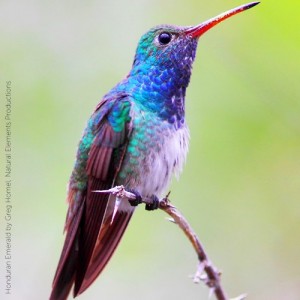
Photo of the only bird endemic to Honduras.  The Honduran Emerald occurs only in a few spots in Honduras, and nowhere else in the world.  Photo credit: Greg Homel, Natural Elements Productions.


Here is information quoted directly from the American Bird Conservancy website:


The Honduran Emerald
The Honduran Emerald is found only in the small Central American country of Honduras, where it is the country’s only endemic bird species. This, combined with its endangered status, makes it a high priority for us and our local partner ASIDE.
Part of the hummingbird population occurs in remnant tropical dry forest habitat in the Agalta Valley, where most of the habitat suitable for the hummingbird has been cleared for cattle grazing and other agricultural purposes such as fruit production.
     During the last 10 days of my time in Honduras, I will be participating in the Honduras Birding Tour for Conservation http://hondurasbirdtour.com/.  This tour will take me back to Lake Yojoa, to the area around the Copan Ruins (from the Mayan civilization) in western Honduras, and the north coast around Pico Bonito National Park, and finally finishing up back in San Pedro Sula.  I will be participating on a team led by Jeff Gordon, president of the American Birding Association and local Honduran bird guides to raise awareness among the birding community of the potential of Honduras as a birding destination.  This part of my trip will allow me to meet with members of birding clubs in La Ceiba (near Pico Bonito National Park) and in San Pedro Sula.

     Please consider helping to support this effort by making a contribution towards my in-country travel:  www.gofundme.com/2rha68nv.  Stay tuned for more information!