Showing posts with label sister bird clubs. Show all posts

Wednesday, November 30, 2016

Calling all Bird Clubs to join a network of Sister Bird Clubs stretching throughout the Americas


             Neeotropical migratory birds connect our clubs.  For many of the bird clubs in Canada and the U.S., our "birds of summer" are
Members of the Cayuga Bird Club in Ithaca, NY enjoying our
"birds of summer."  Photo credit: Jody Enck
the "birds of winter" for Clubs in Central and South America.
 We know these birds.  We enjoy seeing them and being thrilled by their songs.  We anticipate their arrival and lament their departure. 
          These birds course through our veins, and fill us with life.  If
One of our declining Neotropical migratory warblers -
Black-throated Green Warbler.  Photo Credit: Greg Lavaty.
bird migration is the heartbeat of healthy ecosystems and habitats stretching the length of the Americas, then birds are like the blood cells flowing along those migration pathways.
 In spring, their arrival brings a breath of fresh air to those of who have been holding our breath all winter waiting for their return.  Just like a blood cell carrying oxygen, they nourish us in so many ways.

It’s a little different in the Fall.  We do get excited about s
Holding on to another Neotropical migrant for just a little
while longer.  A Northern Parula being banded at the 
National Audubon Society's Hog Island Camp.   
Photo Credit: Jody Enck.
eeing bird species that pass by twice a year on migration.
  But this also is a melancholy time as we know many of our breeding "birds of summer" will be joining those other migrants on their annual pulse.  Winter will be coming soon again for those of us in the north, and we want to hold on to our "birds of summer" just a little while longer.

But, our loss as birders in the northern part of the hemisphere is a gain for birders in clubs father south.  I know that
Members of Las Tanunas Club de observaciones de aves
from Gracias, Honduras birding one of their favorite hotspots
looking for their "birds of winter."  Photo credit: Jody Enck.
birders on the wintering grounds look forward to their "birds of winter" just as much as we northerners look forward to the arrival of our "birds of summer."
  These same birds nourish birders in the south, too.

Yes, Neotropical migratory birds nourish all parts of our birding community regardless of where we live in the Hemisphere.  We know a fair amount about those birds – their ecology, behaviors, and migration pathways.  But, what do we know of other birders along those migratory pathways?  Wouldn’t it be great to connect with them through a network of sister bird clubs?

Members of Los Jilgueros club de observaciones de aves from
Mancala, Honduras work with school kids to learn about birds.
Photo Credit: David Andres Hernandez Vasquez.
If you’ve been following this blog for the last couple of months, then you know that one of my dreams is to help develop such a network.  To start bringing this dream to reality, I spend about a month in Honduras from mid-October to mid-November meeting with members of six of the seven bird clubs in the country.  The response to the idea of establishing a network of sister bird clubs between North and Central America was remarkable.  I returned to the U.S. more excited and energized than I have felt in a long time.

Now, I want to build some momentum.  The clubs in Honduras generated some great ideas about why they want to be part of a sister club network and how they see that playing out.  The club to which I belong – the Cayuga Bird Club in Ithaca, NY – has some ideas, too.  What about the rest of you?  Surely there is interest among other clubs in North America to be part of a network of sister bird clubs.  Here is your chance to get on the bandwagon while it’s still moving slowly. 
Please join me in working with my new friends, Hector Moncada (left, from
Club Los Zorzales in San Pedro Sula, Honduras) and Francisco Rovelo (right, from
Club Las Tanunas in Gracias, Honduras) to build a network of sister bird clubs
throughout the hemisphere.  Photo credit: Jody Enck.

Are you interested in joining?  What would you want to get out of this network?  What would you like to help facilitate through the network?  Please help us bring this dream to reality by leaving ideas and your contact info in the comments section below.  I’ll be in touch!


Tuesday, October 18, 2016

Lake Yojoa Birding Blitz was a Huge Success!


The Lake Yojoa Birding Blitz was a great success!  About forty participants from all over Honduras (and two of us from the United States) spent four days observing, identifying, and documenting birds at about ten locations in the Lake Yojoa area.  With a few more eBIrd checklists to the submitted (yes, that includes me although I have not had access to wifi for a couple days), we are up to 299 species found by the participants.  Most importantly for me, I not only enjoyed finding and seeing almost 200 species of birds myself over the four days, but I found a couple of dozen new friends while participating in the Blitz. 

If you have been following this blog over the last couple of weeks, you know that I have traveled to Honduras as part of an effort to establish sister birding clubs in Central and North America.  Many populations of Neotropical migratory bird species are declining.  Major causes for those declines include loss of habitat on breeding grounds in North America and on wintering grounds in Central America.  Birders in North America and Central America are inexorably linked by the birds that travel between our homes, by our love of the birds, by our concern for those birds, and by our desire to help conserve those birds on into the future. 

I can’t possibly list all the new friends I met from the groups represented at the Blitz.  Here are just a few of the new friends I met from about half of the Clubs in attendance... 

Two of the youngest participants in the Blitz were Norman Espinoza and Daniel Torres.  Both are 16-years old and fairly new birders.  Along with their adult leader, Francisco Rovelo, they represented a youth birding club called the Hummingbirds.  They are a relatively new club associated with Las Tanunas Club (named after Lesser Roadrunners) from in Gracias in Lempira Department.  Daniel and Norman may have been the only birders participating in the Blitz who saw more life birds than me.  Their enthusiasm, deep desire to learn birds, and their wonderful good nature especially brightened a couple of the field trips in which I participated.  I think they would make a couple of great candidates to attend the Cornell Lab of Ornithology Young Birder event next summer.  Although they spoke English pretty well, I gave them Spanish-language Kaufman guide to birds of North America (donated by Gladys Birdsall), so they would have information in Spanish about the Neotropical Migratory Birds we share.
New friends Daniel Torres (left), adult leader Francisco Rovelo, and Norman Espinosa (right) from
Club Hummingbird in Gracias, Honduras (Lempira Department).  Photo credit: Francisco Rovelo.


Two awesome new friends from San Pedro Sula are Hector Moncada and Marlen López.  They are from Club Zorzales (named after Clay-colored Thrush) in San Pedro Sula.  In addition to being a birder, Hector is a scout leader with a deep passion for conservation.  One of his great ideas is to go birding with his friends from the club and then get everyone to go plant some native trees as a habitat restoration project.  He has been birding for about a year, and already has an incredible handle on identifying Honduran birds by sight and sound.  Marlen studies bees and is a bee-keeper.  She only started birding this past spring, and I was impressed that she wanted to attend this event.  In addition to studying all the birds carefully through her binoculars, she took many pictures so she could study those back home.    

Angel Fong is from Los Alzacuanes Club (aka Migratory Raptors) in Tegucigalpa.  An accountant by training, Angel also is an avi-tourism guide.  Not only is he friendly and helpful, he made me laugh a lot!  He was on several of the field trips I attended.  Often he was the person in charge of recording the species and abundance data for entry into eBird.

A boat load of new friends!  Guide William Orellana (left), Angel Fong from Club Alzacuanes in
Tegucigalpa, Victor Gálvez from Club Clorofonia, me, and Marlen López from Club Los Zorzales
in San Pedro Sula.  Photo credit: William Orellana.  


David Hernández and Sarahí Morales are from Club Jilgueros (Goldfinch) in Marcala (La Paz department).   This Club just got started and they don’t have much in the way of birding equipment or resources.  We chose this club to receive the two binoculars donated by Donna Scott and Wes Blauvelt from the Cayuga Bird Club in Ithaca, New York, which is my home bird club.

In my next blog post, I’ll share some information about some of my other new friends from Club Tanunas (Lesser Roadrunner) in Gracias, the local Club in Lake Yojoa – Clorofonia (named for Chlorophonia), and from the Honduran Institute for Forest Conservation, Protected Areas and Wildlife (ICF).  Members from all the groups participating in the Blitz expressed a lot of excitement about the ideas of developing a sister-club relationship with birding clubs in North America.  Throughout the Lake Yojoa Birding Blitz, it was obvious that these mostly young adults are passionate about birds and about bird conservation.  They are very interested in sharing their experiences and their birds with anyone who comes to Honduras to visit.  I hope all of you reading this blog will help support this effort to establish sister birding clubs. 


Tuesday, October 11, 2016

Establishing Sister Bird Clubs in North and Central America -- The Adventure Begins!

          October 11th, 2016.

           Today it became real.  The planning is done -- at least as much as can be done from a long distance away.  My bags are packed, and I only had to leave a few, unimportant items behind.  Don't know how much my bags weigh, but I suspect I be paying overweight charges at the airport.  In addition to the 16 copies of the brand new field guide to northern Central America by Jesse Fagan and Oliver Komar, I am also taking along several other, older field guides and a couple pairs of binoculars donated by members of the Cayuga Bird Club to distribute to birders in Honduras.  Plus, the Cornell Lab of Ornithology graciously donated a number of items for me to take as well.

Packing my bags.  More items to donate to bird clubs in Honduras than clothes
for me to wear.  Thanks to members of the Cayuga Bird Club and to the Cornell
Lab of Ornithology for donating items for me to take down to Honduras to share with
birders there.  Photo credit: Jody Enck

          After packing my bags and making some last minute email connections with more people to visit in Honduras, I loaded the car and headed towards Philadelphia.  I'm staying with my niece, nephew-in-law and their two kids tonight.  Then I'll fly out of Philadelphia early tomorrow morning. 

          The only challenges on the way down were a non-functioning GPS (thankfully, I had good ol' hand-written directions as a back-up), and a check engine light that came on when I got near my destination (I'll deal with that when I get back from Honduras.

          I stopped and took a couple of pictures of the amazing fall foliage near Ithaca before I left town.  By the time I get back from Honduras, all those colors will be a distant memory.  The trees near Ithaca will be bare, and there could even be some skiffs of snow on the ground. 

all colors on a hillside outside of Ithaca, NY today.  It sure won't
look like this when I get back from Honduras in a month.
         The calendar might say it's fall, but it sure will not feel like fall in Honduras.  Temperatures in the lower-elevation areas will range from the mid-80s to the mid-90s F during the day and only get down into the 70s F at night.  Even the higher elevation areas won't exactly be cool.

          My adventure has started.  I am excited to meet some of the wonderful people of Honduras, to see some neat birds and other animals, and to learn something of how Hondurans relate to our "birds of summer" when they become their "birds of winter."  There still is time to donate to this effort to support my travel within Honduras.  Head on over to my campaign site, and check it out. 


Thursday, October 6, 2016

Getting Ready to Meet Birding Clubs in Honduras

          Less than one week to go before I head to Honduras to meet with Birding Clubs there about the idea of establishing a network of sister clubs between Central and North America.  Many of the bird species that we think of as our "birds of summer" are experiencing steep population declines.  One of the major culprits is habitat loss in both breeding and wintering areas.  As a birder living the in northeastern U.S., I know first-hand how much the dawn chorus of birdsong has diminished over the last couple of decades.  Next week, I'll get to see first-hand what the habitat conditions are like where some of "our" birds, like Wood Thrush, Golden-winged Warbler, Baltimore Oriole, and Rose-breasted Grosbeak overwinter. 

          To get ready for my trip, I have been studying about Honduras, trying to bone up on my limited skill at speaking Spanish, and of course learning all I can about the birds I'll see in Honduras.  Luckily for me, I have the privilege of getting my hands on a copy (well, 16 copies actually) of the brand new Peterson field guide to birds of northern Central America by Jesse Fagan and Oliver Komar.  This book came off the presses at the beginning of October, just in time for the Honduras Birding Tour for Conservation.  It also will come in handy when I participate in the Lake Yojoa Birding Blitz where I will meet some of the members of the Tautunas Birding Club from the city of Gracias in Lempira department. 

         What am I going to do with 16 copies of this field guide, you ask?  I'll be hand-carrying these down to Honduras to give to co-author Oliver Komar at Zamarano University where they will be used for educational purposes.  It's a great field guide, covering Guatemala, Belize, El Salvador, and Honduras.  The book illustrates and describes 827 species of birds that occur regularly in northern Central America, including the 763 species that are possible to see in Honduras. 

          My plans for meeting with Birding Clubs in Honduras continue to evolve and firm up.  Last night and this morning I've been working on arrangements for meeting with members of the Cotinga Bird Club in La Ceiba on the north (Caribbean) coast in Atlantica department.  This is one of six clubs in the country with whom I hope to interact during my trip.  Remember that you can follow along with my travels on this blog.  Plus, it's still not too late to help support my in-country travels at my Go Fund Me campaign

          Excitement is building.  Now it's time to get back to studying! 

Tuesday, October 4, 2016

Getting ready to see our "Birds of Summer" at their homes in Honduras


          I leave for Honduras a week from tomorrow.  Part of my trip will be devoted to meeting with local birding clubs in Honduras to explore the idea of establishing a network of sister birding clubs in North and Central America. 

          I envision several specific outcomes from establishing the network of sister birding clubs.  Initially, we can start a virtual relationship through which we skype, share slides, stories, etc. of what is going on with migratory birds in our areas (e.g., timing of migration, species, seen, pictures and video of the habitats used by these birds, relationship (or lack of relationship) between these birds and the lives and livelihoods of birding club members, etc.).  North American clubs can obtain and donate resources (e.g., optics, field guides, etc.) to Central American clubs, which largely lack these resources.  Ultimately, I envision some reciprocal visits.  Nort Americans can go visit the small communities where these Honduran clubs occur, stay in local (not ecotouristic lodges) accommodations, eat in local restaurants, and make a commitment to buy shade-grown coffee.  I’d also love to have kids in the clubs start a pen-pal kind of relationship with each other.  The ideas and possibilities are endless.  I hope to learn from them what would be useful and meaningful when I am in Honduras.


Members of the Cayuga Bird Club in Ithaca, NY scanning Cayuga Lake
for birds in the late fall.  What birds that either breed in NY or pass
through on migration will I see in Honduras?  Photo credit: Jody Enck
          What benefits to North American clubs do you think could come out of a network of sister birding clubs linking the migratory pathways of Neotropical migratory birds?  Put your ideas in the comments section and I'll post about them in the future.

          It's not too late to donate travel funds to this project.  Please go to this link to support my travel within Honduras to meet with the local birding clubs there.  Thanks!


Friday, September 23, 2016

More on Saving the "Birds of Summer" by establishing Sister Birding Clubs

     Yesterday in this blog, I introduced the effort being initiated by the Cayuga Bird Club in Ithaca, NY to establish a network of bird clubs linking the breeding and wintering areas of some of the migratory neotropical birds that have been declining substantially over the last couple of decades.  Today, I want to share some additional plans that have been coming together.  I will keep posting additional updates here, including posts from Honduras when I am there in October and November meeting with some of the birding clubs there.

     Six clubs currently exist in Honduras.  They all were established relatively recently with the help of the Honduras Ornithological Association (ASHO).  These clubs are scattered around Honduras, a country about the size of Virginia. 


A Baltimore Oriole feeding in my backyard in Ithaca, NY in August 2016 (phot credit: Jody Enck).  This oriole could well indeed spend the upcoming winter in Honduras. 

     My main plan is to be in Honduras from mid October until mid November.  First, I will take part in the Lake Yojoa Birding Blitz facilitated by Beaks and Peaks, a wonderful, local eco-tourism company out of Gracias Lempiras, in the west-central region of Honduras.  (Check out their website at Beaks and Peaks).  Here is a quote from the website about the Birding Blitz:

"With your participation in the Lake Yojoa Birding Blitz, you contribute to a deeper scientific knowledge of the avifauna in this hugely biodiverse region and to the promotion of Honduras as a birdwatching and nature destination par excellence. Furthermore, part of the tour price will be donated to the Honduran Ornithology Association (ASHO) and will be used to support local birders and bird watching clubs, to organize training for aspiring bird watching guides and to encourage further data collection by means of bird counts and monitorings in the area and in other parts of the country."

One of the birding clubs in Honduras is located very near Lake Yojoa, and I'll get a chance to meet and bird with them while at the Birding Blitz.


     After taking part in the Lake Yojoa Birding Blitz, I will accompany Oliver Komar, a professor at Zamarano University and a member of the board of ASHO, down south to the capital city of Tegucigalpa.  There I will meet with faculty and students at the University to discuss how local birding clubs can assist with on-the-ground bird conservation efforts.  I'll also have a chance to meet with the birding club based in Tegucigalpa.

     Over the next couple of weeks I plan to travel to western Honduras to meet with a club called Tanunas in the department (state) of Gracias, and to north-central Honduras to meet with a club in Catecamas (Olancho department).  The American Bird Conservancy has a presence in Catecamas through their in-country partner NGO --  the Honduran Research Association for Ecological and Socioeconomic Development (ASIDE). 

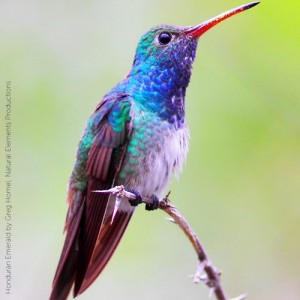
     The bird club in Catecamas and ASIDE work on sustainable community development issues, and conservation projects of importance to both neotropical migratory birds as well as resident species, like the Honduran Emerald. 


Photo of the only bird endemic to Honduras.  The Honduran Emerald occurs only in a few spots in Honduras, and nowhere else in the world.  Photo credit: Greg Homel, Natural Elements Productions.


Here is information quoted directly from the American Bird Conservancy website:


The Honduran Emerald
The Honduran Emerald is found only in the small Central American country of Honduras, where it is the country’s only endemic bird species. This, combined with its endangered status, makes it a high priority for us and our local partner ASIDE.
Part of the hummingbird population occurs in remnant tropical dry forest habitat in the Agalta Valley, where most of the habitat suitable for the hummingbird has been cleared for cattle grazing and other agricultural purposes such as fruit production.
     During the last 10 days of my time in Honduras, I will be participating in the Honduras Birding Tour for Conservation http://hondurasbirdtour.com/.  This tour will take me back to Lake Yojoa, to the area around the Copan Ruins (from the Mayan civilization) in western Honduras, and the north coast around Pico Bonito National Park, and finally finishing up back in San Pedro Sula.  I will be participating on a team led by Jeff Gordon, president of the American Birding Association and local Honduran bird guides to raise awareness among the birding community of the potential of Honduras as a birding destination.  This part of my trip will allow me to meet with members of birding clubs in La Ceiba (near Pico Bonito National Park) and in San Pedro Sula.

     Please consider helping to support this effort by making a contribution towards my in-country travel:  www.gofundme.com/2rha68nv.  Stay tuned for more information!