Tuesday, September 27, 2016

Saving our "Birds of Summer" by drinking (the right) coffee


OK, so you’ve read my posts about trying to save our “Birds of Summer,” the ones that migrate to Central and South America for the winter, by establishing a network of sister birding clubs in North and Central America.  Some of you have even contributed to my Go Fund Me campaign (www.gofundme.com/2rha68nv) to support my travel within Honduras to meet with birding clubs there.  Many more of you are probably scratching your heads and saying: what can I do personally to help save our “Birds of Summer” if I am not a member of birding club?

One easy answer is to buy shade-grown coffee.  Coffee beans are found on shrubs in the understory of tropical forests.  According to conservationist and author Scott Weidensaul (https://abcbirds.org/northern-climes-to-nicaragua-long-distance-migrants-on-shade-coffee-farms/), coffee trees in Central America were cultivated and tended in the natural, shady, understory of these forests for about 200 years prior to recent conversion millions of acres of neotropical forest to sun-grown coffee plantations.  Traditionally, coffee beans were harvested from these understory trees by small-scale farmers, and the rest of the forest trees provided necessary habitat for a diverse array of animals.  Just in the past few decades, larger-scale commercial ventures started removing the forest to plant coffee trees in full-sun plantations.  Out in the sun, the coffee plants produced a greater quantity of beans compared to shade-grown coffee plants, and they were easier to harvest.  But, the higher quantity has come with a very stiff price.
Hooded Warbler is one species that heavily use shade-grown coffee areas and virtually avoid full-sun coffee plantations.  Photo credit Birdspic.com.

Sun coffee requires many more chemical inputs than shade-grown coffee, including petroleum-based fertilizers, insecticides, and other pest-control efforts.  Shade-grown coffee can, and is, grown commercially in the understory of thinned forests.  Those forests retain a high level of the natural diversity of plants, animals, and insects that occur in unmanaged forest.  For example, shade-grown coffee farms in the state of Chiapas, Mexico have been reported to contain more than 180 species of birds, including more than four-dozen migratory species.  Sun coffee plantations nearby were found to contain only eight species, and generally were shunned by Neotropical migrants. 

Similarly, in Nicaragua, just south of where I’ll be in Honduras, a joint team of researchers from York University in Toronto and Hawk Mountain Sanctuary in Pennsylvania surveyed shade-grown coffee producing areas and adjacent, full-sun coffee plantations for birds.  They found more than 130 bird species in the shade-grown areas, including a vast array of Neotropical migrants.  In the full-sun plantations, they found only a handful of bird species.  Clearly, shade-grown cultivation of coffee is necessary to protect birds.

The more diverse array of plants, animals, and insects found in shade-grown coffee operations provide for a more stable and complex food system.  All those birds help to keep coffee pests under control, virtually eliminating the need for pesticides.  Similarly, the natural ecological processes that can continue to occur in shade-grown coffee areas lessens some of the other challenges that occur in sun coffee plantations, like soil erosion and the need for chemical fertilizers. 
Chestnut-sided Warblers use shade-grown coffee areas on their wintering grounds.  Their population has declined 44% between 1966 and 2015, in large part because of habitat loss.  Photo credit: Planetofbirds.com.


In addition, taste tests have repeatedly shown that shade-grown coffee is of higher quality and tastes better than full-sun coffee.  The main reason for this is that it takes longer for the beans to mature and ripen in the shade.  This longer ripening process produces a more complex and robust flavor in the beans compared to the beans that ripen more quickly in the full sun.

Another huge benefit of the shade-grown coffee production is that much of it is produced by cooperatives of small-scale farmers using organic farming methods.  They can tend and harvest this crop without the harmful effects of chemical fertilizers and pesticides.  Maintaining the overstory of forest and the diversity of plants and animals in that forest also is better for soil and water conservation in these areas compared full-sun coffee.  These local communities clearly benefit from shade-grown coffee, too.

I admit it – I am a coffee-drinking fiend.  The good news is that I don’t have to stop drinking coffee.  I just have to make the choice to buy bird-friendly, shade-grown coffee.  You can do this easy act, too, to help protect our “Birds of Summer.”

Finding shade-grown coffee in the U.S.

            When you buy coffee, look for bird-friendly certification by the Smithsonian Migratory Bird Center.  One of the few certified sellers of bird-friendly coffee in the U.S. is a company called Birds and Beans.  If you can’t find their product in your local grocery store, you can order it to be delivered right to your door from

Baltimore Orioles winter in Central America, especially in shade-grown coffee producing areas.  Their population has declined by about a quarter since 1966 because of habitat loss.  Photo credit: Shea1.blogspot.com.

Friday, September 23, 2016

More on Saving the "Birds of Summer" by establishing Sister Birding Clubs

     Yesterday in this blog, I introduced the effort being initiated by the Cayuga Bird Club in Ithaca, NY to establish a network of bird clubs linking the breeding and wintering areas of some of the migratory neotropical birds that have been declining substantially over the last couple of decades.  Today, I want to share some additional plans that have been coming together.  I will keep posting additional updates here, including posts from Honduras when I am there in October and November meeting with some of the birding clubs there.

     Six clubs currently exist in Honduras.  They all were established relatively recently with the help of the Honduras Ornithological Association (ASHO).  These clubs are scattered around Honduras, a country about the size of Virginia. 


A Baltimore Oriole feeding in my backyard in Ithaca, NY in August 2016 (phot credit: Jody Enck).  This oriole could well indeed spend the upcoming winter in Honduras. 

     My main plan is to be in Honduras from mid October until mid November.  First, I will take part in the Lake Yojoa Birding Blitz facilitated by Beaks and Peaks, a wonderful, local eco-tourism company out of Gracias Lempiras, in the west-central region of Honduras.  (Check out their website at Beaks and Peaks).  Here is a quote from the website about the Birding Blitz:

"With your participation in the Lake Yojoa Birding Blitz, you contribute to a deeper scientific knowledge of the avifauna in this hugely biodiverse region and to the promotion of Honduras as a birdwatching and nature destination par excellence. Furthermore, part of the tour price will be donated to the Honduran Ornithology Association (ASHO) and will be used to support local birders and bird watching clubs, to organize training for aspiring bird watching guides and to encourage further data collection by means of bird counts and monitorings in the area and in other parts of the country."

One of the birding clubs in Honduras is located very near Lake Yojoa, and I'll get a chance to meet and bird with them while at the Birding Blitz.


     After taking part in the Lake Yojoa Birding Blitz, I will accompany Oliver Komar, a professor at Zamarano University and a member of the board of ASHO, down south to the capital city of Tegucigalpa.  There I will meet with faculty and students at the University to discuss how local birding clubs can assist with on-the-ground bird conservation efforts.  I'll also have a chance to meet with the birding club based in Tegucigalpa.

     Over the next couple of weeks I plan to travel to western Honduras to meet with a club called Tanunas in the department (state) of Gracias, and to north-central Honduras to meet with a club in Catecamas (Olancho department).  The American Bird Conservancy has a presence in Catecamas through their in-country partner NGO --  the Honduran Research Association for Ecological and Socioeconomic Development (ASIDE). 

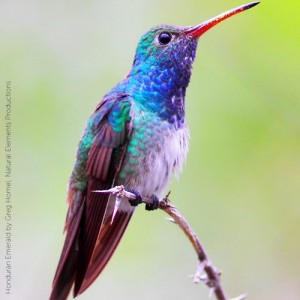
     The bird club in Catecamas and ASIDE work on sustainable community development issues, and conservation projects of importance to both neotropical migratory birds as well as resident species, like the Honduran Emerald. 


Photo of the only bird endemic to Honduras.  The Honduran Emerald occurs only in a few spots in Honduras, and nowhere else in the world.  Photo credit: Greg Homel, Natural Elements Productions.


Here is information quoted directly from the American Bird Conservancy website:


The Honduran Emerald
The Honduran Emerald is found only in the small Central American country of Honduras, where it is the country’s only endemic bird species. This, combined with its endangered status, makes it a high priority for us and our local partner ASIDE.
Part of the hummingbird population occurs in remnant tropical dry forest habitat in the Agalta Valley, where most of the habitat suitable for the hummingbird has been cleared for cattle grazing and other agricultural purposes such as fruit production.
     During the last 10 days of my time in Honduras, I will be participating in the Honduras Birding Tour for Conservation http://hondurasbirdtour.com/.  This tour will take me back to Lake Yojoa, to the area around the Copan Ruins (from the Mayan civilization) in western Honduras, and the north coast around Pico Bonito National Park, and finally finishing up back in San Pedro Sula.  I will be participating on a team led by Jeff Gordon, president of the American Birding Association and local Honduran bird guides to raise awareness among the birding community of the potential of Honduras as a birding destination.  This part of my trip will allow me to meet with members of birding clubs in La Ceiba (near Pico Bonito National Park) and in San Pedro Sula.

     Please consider helping to support this effort by making a contribution towards my in-country travel:  www.gofundme.com/2rha68nv.  Stay tuned for more information!


Thursday, September 22, 2016

Saving Migratory Birds by Establishing Links Between Sister Birding Clubs in North and Central America


     In another part of my life, I’m the president of the Cayuga Bird Club in Ithaca, NY.  Our club is interested in working with other clubs to establish a network of sister birding clubs at the northern and mid-southern (Central America) ends of the migratory flyway.  Populations of many of our Birds of Summer (many warblers, thrushes, vireos) are declining because of habitat loss on both breeding and wintering grounds.  At the same time, Central American endemics like Lovely Cotinga, Resplendent Quetzal, and Honduran Emerald are declining even faster because of their very specific habitat needs.  While bird conservationists are well aware of these dilemmas, many birders here and in Central America are less aware.

               For example, only about five years ago, the Honduran Ornithological Association (ASHO) started developing birding clubs in about a half-dozen locations throughout the country.  Just like birders here in North America, they enjoy watching birds.  However, they lack many basic resources like binoculars, field guides, access to places to bird, and access to local, Spanish-speaking birding trip leaders.  Further, little incentive exists in countries like Honduras to care about the impacts of habitat loss on birds because so few residents realize the importance of birds for the ecosystem services they provide (how many disease-carrying mosquitoes can a bird eat in a day?) and how they are indicators of how sustainable the local ecosystem is.  In part to bring more awareness to the birding opportunities in Honduras, and in part to raise funds for bird conservation there, the Honduran Tourism Bureau is sponsoring the first-of-its-kind Honduras Birding Tour for Conservation.  I have decided to participate in this event in November 2016. 

               I am going down to Honduras in mid-October to travel to as many of the six existing birding clubs in the country as possible to explore the idea of connecting with us as sister birding clubs.  Likely, this would mean starting out by connecting virtually through print and electronic media, skyping, and sharing pictures and stories.  Ultimately, we would like it to involve visits with our sister clubs.  The possibilities, and the benefits to birds and birders, are constrained only by our imaginations!
               Travel within Honduras to meet with the various clubs will take time and money for transportation, food, and lodging in the birding communities.  To make that part of my trip to Honduras possible, I have started a Go Fund Me campaign https://www.gofundme.com/2rha68nv. Please consider making a donation, and consider sharing this link with your members and other birding friends.

Friday, May 13, 2016

Situational Interest and Personal Interest -- Going Beyond the Fireworks

There is an old adage that goes something like this:  If we make education activities fun, kids will want to keep coming back to learn more.  Of course, there is a lot of truth to that adage.  Social science studies have shown that exposing youth (and adults) to new, surprising, or unexpected ideas through fun activities is a great way to stimulate situational interest in a given topic area, like birding, ecology, or science (Shraw and Lehman 2001).  This kind of interest most often develops from “gee-whiz” experiences that are a lot like going to watch fireworks.  You may not know exactly what you’re going to see, but you have a pretty good idea that you’ll have fun watching fireworks.  So, you make plans to go watch them every 4th of July or at the county fair, or even at a ballgame.  It can be similar with informal education opportunities that might occur through birding events.  If kids had a pretty good idea that they were going to have fun, why wouldn’t they want to keep coming back?
Of course, getting the kids to want to keep coming back is just part what is important.  One of the main points of informal education is the idea of positive youth development and facilitating the emergence of character, competence and connections to other people among other outcomes.  How does this relate to fireworks and having fun?  Perhaps the surprising answer is that there is very little relationship!
Social science research over several decades (e.g., see Shraw and Lehman 2001) has shown that situational interest most often results from some external stimuli – somebody else has to set off the fireworks for you.  So the fun that results depends pretty much entirely on someone else orchestrating the situation.  Experiencing fun from situational interest requires no particular competency on the part of the person having the fun, nor does it necessitate any real connection to those orchestrating the event.  People who experience this kind of externally-produced fun from having their situational interest piqued, but who do not develop much competency in terms of understanding what underlies the “gee-whiz” aspects of the experience, are not able to reproduce that fun in another setting (for example, at home, or with friends in their neighborhood).  So, the risk is very high that they will become what evaluators sometimes call “program junkies.”  They keep coming back for the fun, but can’t replicate it on their own.  So, they become locked into a cycle of attending the program activity to experience that “gee-whiz” fun without ever developing deeper competence or connections (Hidi and Renninger 2006).
So, how can educators and students have fun, get interested in things like birds, ecology, or science, and develop some competence and connectedness?  One of the keys is to facilitate deep, reflective thinking as a part of activities that provide some fun fireworks.  Providing some new information about birds (Bluebirds and Wild Turkeys have different kinds of beaks and can eat different kinds of foods, Bluebirds typically lay 4 bluish eggs whereas Turkeys lay about 11-12 whitish eggs, and Bluebirds and Turkeys use somewhat different habitats) can be done through fun games and can result in an increase in content knowledge (i.e., learning) on the part of youth. 
Why are these facts important to the birds?  Why would it matter to Bluebirds that they lay 4 eggs instead of 11, or blue eggs rather than white, or have different habitat requirements compared to Turkeys?  And, why do any of these things matter to the kids who are learning them?  
Reflection guided by someone who thinks like a science-person leads to deeper scientific understanding and meaning-making (Eberbach and Crowley 2009).  Social science research (Hidi and Renninger 2006) has shown that such reflection is essential to result in those situations where someone stops in their tracks and exclaims, “Now I get!”  These “a-ha” moments are more like light bulbs going on inside one’s head rather than fireworks being observed passively.  The light bulb going on signifies a depth of understanding and meaning about what one knows.  It signifies a level of competence unachievable through the combination of knowledge accumulation and skill development in the absence of reflection. 
Social science research also has shown that competence emerging from understanding and meaning-making often leads to enhanced self-esteem and internal motivation to want even deeper understanding.  This is what social scientists refer to as internal interest in a topic area (e.g., Krapp 2002, Hidi and Renninger 2006).  Each “now I get it” experience is fun in its own right.  Perhaps even more important is that fun based on internal interest is under the control of the individual rather than some external source.  Greater understanding fuels more internal interest, which leads to more fun “a-ha” moments, which builds even more competency.  Instead of being locked into a cycle of depending on a program to experience science-related fun, youth have sufficient competency to replicate the fun associated with “a-ha” moments in other settings.    


Caption for this over-sized figure:  Model showing development of a science person identity along a pathway (in arrow) with four stages: un-science person, potential science person, apprentice science person, and fully-recruited science person.  Note the places of situational interest and personal interest (in hexagons) in the pathway.  Development of situational interest is relatively easy to facilitate through exposure to material resources someone can see or hear, and situational interest has little influence on identity development.  Development of personal interest takes longer, requires deeper internal processes, and is instrumental in progressing through the potential science person stage in preparation for entering an apprentice science person stage. 


You can never have too much fun in education programming.  The key is to have a balance of externally-driven fireworks that spark and maintain a certain amount of situational interest while also developing enough competency in the subject area to fuel the emergence of internal interest and the fun that is associated from “getting” the topic area at a deeper level. 

Literature Cited

Eberbach, C. and K. Crowley.  2009.  From everyday to scientific observation: how children learn to
observe the biologist’s world.  Review of Education Research 79(1):39-68.

Hidi, S. and K. A. Renninger.  2006.  The four-phase model of interest development.  Educational
           Psychologist 41(2):111-127.

Krapp, A.  2002.  Structural and dynamic aspects of interest development: theoretical considerations
from an ontogenetic perspective.  Learning and Instruction 12(4):383-409.

Shraw, G. and S. Lehman.  2001.  Situational interest: a review of the literature and directions for   
          future research.  Educational Psychology Review 13(1):23-52.


Thursday, May 12, 2016

Catching up with some Sapsuckers


     Every once in a while I am fortunate enough to be able to conduct a 30-minute stationary count during mid-day at a point in about the middle of the woods adjacent to my house.  Monday was one of those days, and my count was the 47th half-hour count at that site since the beginning of April.  I have seen a lot of that 23.5 hours of observation at the same place in the woods over the last five-plus week.  I want to pass along a bit of natural history I observed that day focused on Yellow-bellied Sapsuckers. 

     I’ve had the great fortune of watching a pair of Yellow-bellied Sapsuckers establish a territory that virtually centers on my point count location.  Over the course of about two weeks in April, I watched as they took turns excavating a new cavity on a Red Maple branch that already had eight woodpecker holes in it.  Indeed, they chased away a pair of White-breasted Nuthatches that seemed to want to use one of the smaller holes on the back side of the branch.  The new Sapsucker cavity was constructed on the branch facing my count point and only about 20 yards away. 

Yellow-bellied Sapsucker at entrance to nest cavity in Red Maple tree.


     As excavation neared completion, I almost laughed out loud watching the male appear from inside the cavity with mouthfuls of wood chips, spit them out in a shower, and disappear back inside for another mouthful.  In addition to watching nest excavation, I have witnessed neat interactions between the pair, including lots and lots of soft mews and other vocalizations I doubt I had ever heard.  Twice I witnessed the female visit the presumably completed nest, disappear inside for a couple of minutes and then depart again.  Once, she sat just outside the cavity and preened for over 10 minutes before going inside for a couple minutes, then emerging and flying away.  Perhaps she was laying an egg at those times.

Reaching in to dig out the back of the nest cavity.


     Monday, I did my count from 1:45 to 2:15pm.  At 1:57, I saw the female emerge from the cavity (I did not know she was in there), and fly to a tree about 50 yards away.  She defecated almost on top of me as she flew over my head, suggesting to me that she might have been in the cavity for a while.  When she landed, she issued on soft mew call that was returned from somewhere just out of site in another direction.  After two minutes, the male flew to the cavity, looked inside, then flew away out of view.  At 2:06, the female return and sat preening right outside the nest cavity.  Then at 2:10 she disappeared inside the nest.

     May their nest be successful.

Sunday, November 17, 2013

Something a little different -- Saturday birding

     I did a little birding in my local area yesterday, and had a lot of fun.  This post won't have any models in it -- just a description of the experience.

          If you put a dot at the intersection of Freese and Hanshaw Roads northeast of Ithaca, and draw a circle of about a mile radius around it, you get the picture of where I was birding.  Besides encompassing my own residence, I like this circle because it includes patches of woods (some rather contiguous with others allowing for some substantial amount of forested habitat from early successional stages up to woods that might be have at least 60-70 years worth of growth).  It also has agricultural fields (corn and soybean in particular) that have recently been harvested and are attracting lots of waterfowl and loafing gulls.  It includes the Freese Road garden plots and similar grassy and old field habitats.  It also includes a section of Fall Creek, the little pond at Liddel Bee Lab and the wetlands at the Lab of Ornithology. 
          I set out Saturday about 9am with the express purpose of trying to see if the NELSON’S SPARROW was still hanging around the little pond by the bee lab on Freese Road.  It had been reported just the day before, so I thought there was a good chance that I might run into it if I was careful and persistent.  I have to admit that I did look for this bird with my sons the day that Tom first reported it (it is only a half mile from my house).  I thought my fledgling birder boys might enjoy trying to see a bird that they had never encountered before.  I am fairly certain that I got two glimpses of the bird with enough diagnostic field marks to say that I saw the bird that day, but the only looks my boys got were of a small brownish bird, twice jumping up out of the tall dead grass, flying about ten feet, and diving back into cover. 
          So, yesterday I headed straight to the pond area.  It is becoming fairly easy to see where others are looking for the bird because of the human foot prints in the mud and the little paths that are now meandering through the tall, dead grass.  I really didn’t want to put on a one-man drive through the grass in an attempt to flush the bird for a quick view.  So, I surveyed the area from a little distance and decided to walk in to the bank of the pond and sit against one of the bluebird/tree swallow boxes to see if I could hear or see this sparrow without flushing it. 

Plans vs. Reality


           Of course I ended up flushing birds just getting to the bluebird/tree swallow box.  One of these was a largish sparrow with a longish, more or less rounded tail, that seemed relatively dark on the top side (do you like my scientific descriptions?).  Perhaps a lingering SONG SPARROW.  

          Another bird was smaller, plumper, but not fat, and not interested in flushing nearly as far as the first bird (which went well over 40 yards before diving back into cover).  This second bird only would go about five to eight feet before hiding again.  This bird decidedly was not the Nelson’s sparrow, however, as I did see it well enough to know it had a very clean, unmarked throat and breast, and a mostly unmarked face, with a couple, broad brownish stripes on its head, and a light-colored bill.  The rational birder in me was saying to pay attention to the fact that it is mid November, and that this must be a juvenile White-crowned sparrow.  But the guy looking at the bird through 10x binoculars at about 12 feet, kept saying that this bird is way too small and simply not the right proportions.  Plus, the face, including the entire area around the eyes and auriculars was unmarked in my view of the bird.  This birder in me kept asking the question, why can’t this be a really late Field Sparrow?  American Tree Sparrow also jumped into the rational side of my brain, and the shape and size of this bird was much more similar to that than a White-crowned for sure.  Still, the bill was all one shade of light (not two-toned like the rational birder in me would expect with a Tree Sparrow), and I did have a decent, straight-on (albeit brief) view of the breast, and saw nothing that looked remotely like a breast spot.  

Un-requited Inquisitiveness


          The inquisitive aspect in me certainly was piqued with this bird, but certainly was not ”peaked.”  I like it when the level of inquisitiveness I experience increases above that magical minimum level that I need to feel both satisfied, and like I have demonstrated to myself that, yes, I am a birder.  Yet another "sparrow spp". in my notebook. 
            I flushed a third sparrow just getting to the place I wanted to sit down to watch.  This little lighter brownish job (LLBJ) also only went about 10 feet at grass-top level before diving back into cover.  I couldn’t really notice anything else about this bird at the time.  So, I sat down to watch and listen.

Relaxed and Observant 


          There was plenty to keep my attention.  Small flocks of blackbirds (mostly RED-WINGED BLACKBIRDS, with a few BROWN-HEADED COWBIRDS mixed in) were flying from north to south and then some coming back north again.  Over the almost square patch of woods to the west of this area, I saw a female AMERICAN KESTREL mobbing and rolling with a SHARP-SHINNED HAWK.  At different times, from one to four of the local AMERICAN CROWS would take offense to one of local RED-TAILED HAWKS perched nearby. 
          At one point about 15 twenty minutes into my sit, I heard a sharp, repeated call note approaching from above and behind me.  I turned around and found the bird in my binoculars.  It was fun to watch it come closer and ultimately land in a little bush just ten feet behind me.  This was without any doubt, a juvenile WHITE-CROWNED SPARROW.  I watched this bird in the bush for about a full minute until it flew to a different bush.  I feel like I got a good handle on its overall shape, and although it’s shape obviously changed as it altered it’s posture in the bush, it simply could not hide the fact that it is a relatively big, chunky, and longish sparrow.  This clearly was not the kind of sparrow as the second one I described above.

Like a Boy Scout -- Be prepared!


          At that point, I had not really seen or heard anything in the grass in front of me.  So, I decided to move on.  You can guess what happened.  I took just one step, and a sparrow flew up from in front of me, flew about seven feet, and landed on top of a little forb of some sort.  I got a really good look at it in profile for about 15 seconds.  A small compact sparrow, with a shortish tail.  Most striking was the orange wash on its breast, face, and even the undertones of its back feathers.  Substantial dark streaking on the orange breast, dark auriculars compared to the orange face, and thick stripes on its crown.  The last thing that seared into my brain before the bird jumped down into the thick over of dead grass was that its bill was decidedly un-sparrow-like.  It really reminded me of a meadowlark bill (and no, this was not a meadowlark!), sort of thick but long and pointed, not conical at all.  This really helped to accentuate a flat-headed appearance of the bird.  Think of a field sparrow or American tree sparrow with their rounded heads and little conical bills that come off of that round ball that is their head.  The NELSONS’S SPARROW has a really flat headed look, and then add this thick-based, but long, pointed bill to it and it gave a very different impression. 

Inquisitive and having a Sense of Discovery

          The inquisitive part of me was very satisfied with that observation.  Despite the fact that others found the bird and had reported it, I felt my own sense of discovery because I felt like I learned something new about a bird I had seen very, very infrequently before.  I walked on with a smile on my face.
          I was still relishing the experience only about 50 yards further on, when my subconscious mind started asking me what that BLUE JAY was squawking about.  I glanced to the north, and there only about 100 yards directly over my house (about a half mile away) I saw a huge, dark bird showing a slight dihedral as it soared/half glided into the south wind.  Even at a half mile it was clear that it was no turkey vulture.  The only question was which eagle it was. 
          The eagle closed the gap fairly quickly, and even flapped once or twice in the half mile between my house and where I was standing.  When I first put binoculars on it, I could see a lot of sunlight reflecting off the feathers on the top of the head of the GOLDEN EAGLE.  The bird ended up flying about 50 yards west of me and about 75 yards up.  I could clearly see a diffuse patching look to its underwing and undertail areas.  Not white patches as in a juvenile, but just the lighter patterns that occur still on older birds.  It’s flight feathers looked to me like a combination of a couple ages -- some brand new feathers and some older ones.  I think it likely was a second year bird although it is possible it was older. 
          When it passed at it’s closest it turned it’s head right toward me on the ground.  Through my binoculars, I almost felt like I could see my own reflection in the glint of it’s eye.  In his book “Birders: Tales of a Tribe,” author Mark Cocker writes about moments like this.  At least for some people, there is both the act of recognition (I know what the species is) and also an increasing sense of awareness and awe that you and this one bird have intersected while the bird is on an epic migration journey.  Cocker describes this as his sense of discovery.  It is as much about discovering something about yourself as it is in discovering the presence of a bird that isn’t common or abundant locally. 
          There are lots of different kinds of birds out there.  And, there are lots of different kinds of birders.  It’s fun discovering both kinds of diversity.
Jody Enck

Tuesday, January 15, 2013

    Birders and Duck Hunters on the Day of the Christmas Bird Count


      Recently, there has been quite a bit of discussion about duck hunters shooting in an area locally on Cayuga Lake that is a favorite of birders in the winter time because the area attracts a lot of waterfowl.  An added complicating factor is that it is near several public tracts of parkland.  Some folks in the birding community have suggested that an effort be made to create a no-hunting zone in the area of greatest waterfowl concentration.  These same people have said that they don't want to eliminate waterfowl hunting on the lake; they just want to stop it in their favorite birding location.  Could this really work?  Would birders and duck hunters both be happy with the situation?

Waterfowl on ice.  From Google images.

The short answer almost certainly is, 'NO'.

          The first challenge is that waterfowl don't use all parts of Cayuga Lake evenly or even randomly.  Cayuga Lake is huge.  It is about 41 miles long and 2-3 miles wide on average.  At it's deepest, it is more than 400 feet deep, meaning that much of it does not freeze in winter.  There are certain spots where they want to be, and other spots they rarely occur except to pass by infrequently. 

Why is this a problem?  Well, see the graphic below.


          Waterfowl hunters really need to be very close to the areas where the waterfowl want to be.  Their effective shooting distance is only about 50 yards (meters), and they prefer to shoot at waterfowl that are even closer than that.  Of course birders prefer to be close, too.  Watching bird behavior and interactions is really fun when the birds fill our field of view or camera viewfinder.  With just about any kind of optics, though, birders can be quite some distance away from birds and still enjoy seeing the crisp details of their plumage. 

           So, segmenting the area into hunting zones and birding zones probably would not be very practical.  This raises another question: why can't birders and hunters tolerate each other enough to actually focus on things that are important to both -- namely, bird conservation issues and habitat protection?  This idea will be the topic of another post.

          Go bird!  And don't forget to buy a federal "duck stamp" formally known as a migratory bird hunting and conservation stamp.  To learn more about the federal duck stamp program, go here:  www.fws.gov/duckstamps/