Sunday, October 30, 2016

Birding with a different kind of Ambassador


               Which people or groups might be called the Ambassadors for birding In Honduras?  There are a number of candidates from among the entities that make up the birding culture in the country. 

Here in Honduras, the Birding Culture is a fascinating mix, not only of individual birders, but also of organizations that are related to birding in some way.  One of the main institutions in the country is the Honduran Ornithological Association (AHSO).  I wrote a bit about ASHO in an earlier post.  
ASHO is the umbrella institution supporting
bird clubs and bird monitoring in Honduras.
Photo credit: Jody Enck
This institution is an umbrella organization for all the bird clubs in Honduras, and it pays particular attention to ensuring that all the clubs have strategic plans, and that birders in clubs strive to maintain the highest levels of integrity when it comes to identification and reporting of birds.  Along these lines, I think it is fair to say that ASHO reflects the scientific and academic research aspects of birding in Honduras.

If you’ve been paying attention to this blog, you know there are about seven or eight birding clubs in the country.  I just spent the last two days in Gracias meeting with Las Tanunas (Lesser Roadrunners) and a school-based group of teens called the Hummingbirds.  I’ll write more about that incredible visit soon.  These clubs and their members are the backbone of the local birding culture.  They draw their members from the local
Members of Club Cotinga giving a presentation about 
recent birding activities.  Photo credit: Club Cotinga
community, provide outreach to schools and other local organizations, and bring awareness of birds and threats to bird habitat to others in their communities.
  Some club members act as bird guides for local residents of Hondurans on vacation to a different part of the country.  They also have established eBird hotspots at great birding locations.  Despite these clubs being the backbone of the birding culture in Honduras, it is possible that visiting birders might never come in contact with the clubs because their existence is not widely known outside of the country.

Another important institution that is part of the birding culture is the network of eco-tourism lodges in the country, and the local bird guides associated with those lodges.  There are some fantastic lodges here where one can stay and be led on great bird hikes.  These include, but are not limited to, Pico Bonito and Rio Santiago on the north coast, Panacam lodge near Lake Yojoa, and Hotel Marina Copan in the west near the Copan Ruinas. 
Pico Bonito Lodge is just one of the splendid eco-tourism
lodges birders can encounter when exploring the birding
culture of Honduras.  Photo Credit: Pico Bonito Lodge.
These lodges and their guides are not part of ASHO, and usually are not formally linked to any of the clubs.  Certainly, though, visiting birders often have direct contact with this institutional aspect of the Honduran birding culture.

There also are a small number of independent guides who are not associated with any of the eco-lodges.  One if Robert Gallardo, who produced a Field Guide to the Birds of Honduras in 2014).  In addition to leading tours, Robert also puts on both bird identification workshops as well as beginner and advanced tour guide training. 

William Orellana and Katinka Domen, of Beaks and Peaks Birding and Adventure Tours, also operate independently from any eco-lodges.  I wrote in one of my first posts from Honduras about William’s vision for Beaks and Peaks.  Now, 18 days into my Honduran odyssey, I have a much better appreciation of just how important these visionaries are to the birding culture in the country. 

 William is a native Honduran who grew up in the small, colonial-era city (it’s church was constructed in 1611) of Gracias in Lempira Department.  He took me there on Friday and Saturday of this week to meet some of the local residents, to see how birds are woven into the fabric of local livelihoods, and to meet with Las Tanunas and the Hummingbirds.  I got to spend some time with Katinka a little earlier on my travels here in Honduras, including during the Lake Yojoa Birding Blitz and on my quick trip to the north coast (blog post here).  After these all these experiences, I think William and Katinka deserve to be considered two of the important Ambassadors for Birding in Honduras.  Below are a few vignettes to show why.

Vignette 1.  Breakfast at Reserva Natural Privada el Consejero near the city of La Esperanza in Intibuca Department.
Beaks and Peaks helped a local landowner realize his dream
of establishing a nature reserve where visitors can come
and have an authentic Honduran nature experience.
Photo credit: Jody Enck.

 Julio is a landowning environmentalist in an area where environmentalists are few and far between.  His small reserve protects a relatively intact patch of high elevation pine forest.  He has a love of birds and other things in nature (he is an expert in mushrooms!).  William and Katinka found out that Julio was interested in birds and wanted to start a hummingbird garden on his property.  Starting in September of 2016, Beaks and Peaks invested time, labor, money, and goodwill in helping Julio establish the first bird-feeding garden in western Honduras.  This garden includes about a dozen hummingbird feeders and a number of native plants that flower in late winter when hummingbirds are looking for plant nectar. 
Julio and me having coffee in the hummingbird garden.  La
Esperanza is the highest-elevation city in Honduras.  It was
quite chilly when we visited although not cold enough to snow
like it did back in Ithaca, NY the previous night. 
Photo credit: William Orellana.


Within just a few days of the feeders being hung up, hummingbirds began using them.  In fact, the first species to take advantage of feeders was a migrant Ruby-throated Hummingbird from North America.  Now, 8 species of hummingbird have been recorded among the 68 total species observed there.  When we stopped to visit and have breakfast with Julio and his family, we saw Mexican Violetear, White-eared Hummingbird, and Azure-crowned Hummingbird, and Magnificent Hummingbird.    After the birds started coming, William and Katinka helped get the word out among members of the birding community that this was a place to see some great birds.  They helped create an eBird hotspot for the site, and they started bringing guest there on Beaks and Peaks tours.
William Orellana of Beaks and Peaks
enjoying an outdoor breakfast prepared
in Julio's home in the background.
Photo credit: Jody Enck.
      A group of birders from the Missouri Audubon Society was so impressed with their recent visit and Julio's hospitality that they are working with him and Beaks and Peaks to obtain a grant so that Julio can build a larger kitchen to offer breakfast to larger groups than he now can handle.  If you ever find yourself on the Central American highway 11-A west of La Esperanza, be sure to stop in and visit this private reserve.
Julio lost several acres of pine trees to an infestation of
pine bark beetle.  He is using some of the wood to build a
new home.  He sold some other timber, and is using that
money to dig a new well.  Photo credit: Jody Enck.
  

Vignette 2.  Visiting the shop of local artist Jose Adelberto Ayala (“Beto”) in Gracias.

               William and I took a little tour of Gracias after our arrival.  Because William grew up in Gracias and visits regularly, he knows many of the people here.  One of the residents we ran into was Beto, who invited us to see his artist shop.  William often talks with Beto about his artwork and about birds.  Beto says that he

"Beto" and me in his artist shop.  He incorporates birds
into his artwork for the non-birding public -- the
"normal people" of gracias.  Photo credit: William Orellana.
may not go birding, but he can bring birds into the lives of non-birders (“normal people”) by painting realistic bird portraits on items that residents use in their lives.  Although Beto may have incorporated birds into his artwork anyway, encouragement from William helped empower him to bring his love of birds to the “normal people” of Gracias.


Vignette 3.  Staying at Guancascos Hotel and Restaurant in Gracias.

Established in 1993, Guancascos Hotel and Restaurant sits on a hillside below the San Cristobal fortress, and was the very first hotel in Honduras to receive an international certificate in sustainable tourism.  I stayed there one night and enjoyed fantastic hospitality and great food in the restaurant on a patio overlooking the town.  We also meet there on Saturday morning with Las Tanunas and the Hummingbirds.
One of the incredible bird murals that greet
you when you enter the Guanacascos Hotel
and Restaurant.  Photo credit: Jody Enck.


Owner Frony Miedema caters to people seeking a connection to nature.  The hotel offers things like hikes up into Celaque National Park (the highest peak in Honduras), and various other nature expeditions and cultural tours of the area.  When you enter the premises, you know right away that birders are welcome here.  Right inside the door are photos of local birds taken by William, along with large bird murals on the walls. 

When Beaks and Peaks brings bird tours to Gracias to explore

Some photos taken by William Orellana
of Beaks and Peaks are incorporated into
bird posters at Guancascos Hotel and
Restaurant to highlight how bird- and
birder-friendly the Gracias area is.  Photo
credit: Jody Enck.
Celaque National Park and other nearby birding sites, they stay here.  It’s an example of one birding business collaborating with the broader tourism sector.  It’s about relationship building.  It’s about not only getting people interested in birds or showing people birds, but ensuring that the infrastructure is sustained to meet the needs of birders in Honduras.


Vignette 4.  Empowering women birders in Honduras.

               In my travels within Honduras, I have come to realize that women birders are a minority here.  This differs from at least some populations of birders in the U.S.  For example, women account for about 70% of members and others who use the services of the Cornell Lab of Orni

Katinka Domen (center) of Beaks and Peaks Birding
and Adventure Tours is a role model empowering
female birders in Honduras.  Photo credit: Katinka Domen.
thology in the U.S.  Katinka Domen is the only woman guide in all of Honduras.  It was clear during the Lake Yojoa

Blitz that she is a role model for women birders here.  She also is an inspiration for others I have met on my travels who do not yet belong to a birding club – in part because they are so male dominated – but who are interested in birds and birding.  Katinka’s opportunity to be recognized as a role model for women birders is likely to grow in the future as she has been asked to write an article about being the only female bird guide in Honduras.


Vignette 5.  Closing the loop back to the birding culture – Las Tanunas and the Hummingbirds.

               Las Tanunas is a group of about 15-20, mostly young men who go birding very frequently, get incredibly excited about seeing the great birds in the area, and who reach out to other community members through school programs and inviting their friends to try out birding.  I’ll write more about them and the Hummingbirds soon. 
Birding with Las Tanunas and the Hummingbirds along the Rio Grande
near Gracias, Lempira Department, Honduras.  Photo credit: Jody Enck.
               This is William’s hometown club.  Although he does not live here anymore, he is good friends with many of the club members.  One of the important roles William plays with Tanunas and the Hummingbirds is to help them envision future possibilities of raising public awareness about birds and the need for conservation of birds and their habitats. 

               As a member of the ASHO board, William worked with Tanunas to develop their strategic plan.  He also is working with the club to produce a letter that will go out to other institutions in the community – tourism bureau, municipal government, schools, etc. – letting them know that the bird club exists and can provide a wide range of services and types of information to members of the community about birds and conservation.  It’s about integrating birds and birding into the broader life of the community.  When I met with Las Tanunas and the Hummingbirds to discuss the sister birding club idea (more on that in another post), William also encouraged Las Tanunas to consider just what the relationship was with the school-based Hummingbird group.  After some spirited and passionate discussion, Tanunas voted to consider the Hummingbirds to be full members of Las Tanunas.
Participants in our joint meeting with Club Las Tanunas and Club Hummingbirds
at Guancascos Hotel and Restaurant in Gracias.  Photo credit: Guancascos Hotel and
Restaurant.


               These vignettes provide just a glimpse into ways that William and Katinka envision a broad, integrated, and collaborative birding culture for Honduras that is inclusive, sustainable, and empowering for all the individuals who are part of that culture.  They don't only want to take people on tours or help club members learn how to identify and monitor birds.  They try hard to provide any visitor with a full experience of connections between birds, birders, other local community members. Certainly, everyone who is part of the birding culture in Honduras is in some way a Birding Ambassador.  But it also is clear to me that William and Katinka help grow and sustain the birding culture here in ways that other entities don’t.  I think that also makes them an inspiration to birders everywhere.


Thursday, October 27, 2016

Interacting with Students and Faculty at Zamorano University through Birds


Last night, I had the privilege of giving a guest lecture to the Biodiversity Club at Zamorano University about an hour south of Tegucigalpa, Honduras.  I spoke about the “Human Dimensions of Natural Resource Management.”  My basic message was that managing natural resources requires an integration of information and actions pertaining to wildlife, habitat, and people.  About 25 students, faculty, and staff attended.  The lecture was more of a rolling discussion stimulated by slides I put together from lectures I’ve given back at Cornell and modified to include issues from Honduras.
After my evening lecture/discussion, I was honored to get this photo with one of the
Assistant Professors (left) and two students.  Note the Syracuse University sweatshirt
worn by one of the students.  I almost felt like I was back home in central New York.
Photo credit: Oliver Komar.


               We didn’t talk only about birds, but bird conservation was certainly a major topic of discussion.  For example, we talked about the situation pertaining to protected areas here in Honduras – particularly National Parks.  There are about 17 National Parks in Honduras.  Each of them has a core area of protection – often at the highest elevations, in an effort to ensure protection of water sources for the many communities that surround the parks.  And by surround, I mean communities that exist within the so-called “buffer zones” of the national parks.  The buffer zones include areas that certainly deserve protection, but often heavily disturbed by human development (both for agriculture and for human habitation).  See the accompanying picture of the map for an example.
A map of Azul Meambar National Park (total area encompassed in yellow and green). 
The green represents the core area that is the highest elevation and which is supposed
to be off-limits to human development.  The yellow shows the buffer zone -- a protected
part of the National Park, but an area containing many small communities and which
is heavily disturbed by human development.  Photo credit: Jody Enck.  

               The communities that exist within the buffer zones not only impact the wildlife and habitat within that buffer zone, but sometimes (perhaps usually), encroach on the core protected area.  You can see examples of clearing on slopes for planning of corn, coffee, beans, bananas, or other crops, and for livestock pasturing.  Human habitation follows as local residents build structures to stay in while working in the encroached fields. 

               Developmental pressures and subsistence needs are great.  The situation is likely to only get worse as human population increases.  The students who attended my discussion pointed out to me that it is not only the responsibility of the government to protect biodiversity within these protected areas.  It also is the responsibility of people who live in these communities within the buffer zones.  One challenge is that most of those residents have no idea about the biodiversity that exists in these areas, why that biodiversity is important to them and to others, or about how their actions negatively affects that biodiversity.

               This point was driven home to me this morning as I accompanied a class from Zamorano University to the Finca Agroecologica Santa Inez.  A sustainable agro-forestry area owned and managed by the university on the slopes above the main campus, which is down in the valley.  Every day during the trimester, students spend half a day in classes and half in a learning-by-doing module that includes a lot of hands-on activities.  One week, the classes are in the morning and learning-by-doing in the afternoon.  Then the next week the schedule flips and learning-by-doing is in the morning. 
Students in a learning-by-doing module conducting an eBird transect count
in the Finca Agroecologica at Zamorano University.  Photo credit: Jody Enck.


               This morning, 11 students from an agro-ecology class conducted a bird census along a transect in the Finca Agroecologica.  Most of these students were not birders or naturalists of any type – fairly representative of the broader population in that sense.  When asked how many bird species we might see on our transect (of a couple kilometers), responses ranged from 8 to 20.  We saw and/or heard 48 species.  The point driven home to me was that even these ecology students are relatively unaware of the biodiversity right here in the campus area.  Of course, as ecology students, their discussion of the morning’s activity focused their attention on the need to help others, especially those living in and adjacent to protected areas, to become aware of the biodiversity around them, the importance of it, and the threats to that biodiversity that exist because of human development.
The entire class of friendly and engaging ecology students who I got to
accompany while they participated in a learning-by-doing model in the
Finca Agroecologica Santa Inez  at Zamorano University. 
Photo Credit: Oliver Komar.


               It is not just a matter of putting a line on a map around a biodiverse area and saying that people have to stay out.  There needs to be some tangible value back to the local residents from that biodiversity.  When eco-tourists come and visit these areas and hire local guides, eat in local restaurants, and stay in local hotels, the local residents can become more aware that maintaining biodiversity is one way to attract economic benefit to the local area.  That is why one important aspect of establishing sister birding clubs likely will be to encourage and facilitate visits by northerners to these areas. 


Sunday, October 23, 2016

Discussing the Idea of Sister Birding Clubs with the U.S. Ambassador to Honduras


               Today, I had the very special opportunity to go birding on the Zamorano University campus with U.S. Ambassador James Nealon.  Luckily for me, and for birders throughout Honduras, the Ambassador has been a life-long birder.  For the past couple of years, he has been very instrumental in facilitating interest and infrastructure development to support avi-tourism in Honduras.  He also played an important role in securing support for the Honduras Birding for Conservation Tour from the President of Honduras. 
U.S. Ambassador to Honduras, James Nealon (right) is an avid, life-long birder.
He joined us for a great bird walk on the Zamorano University campus today.  Photo Credit:
Oliver Komar.
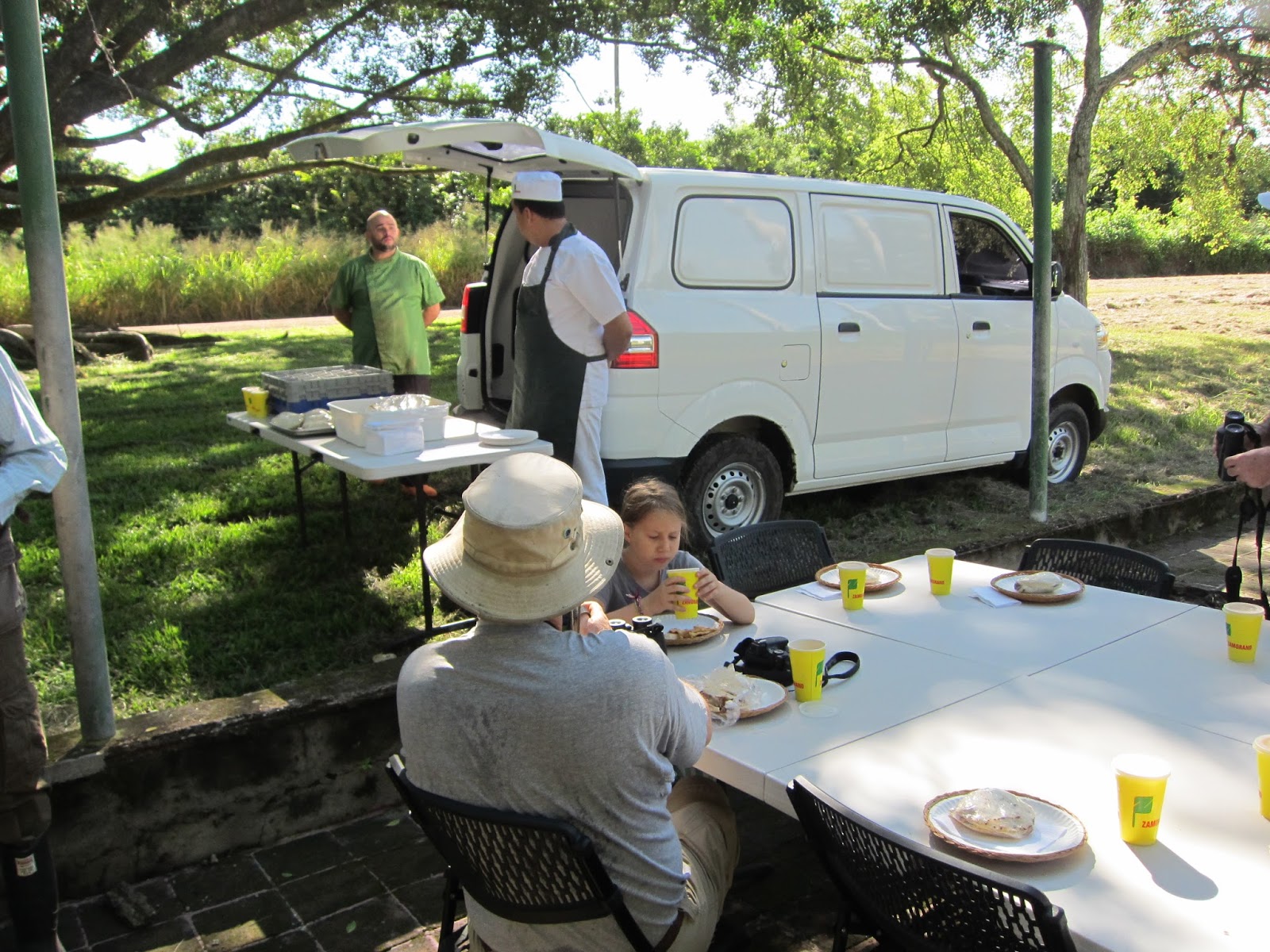
               Thanks to Oliver Komar of the Departmento de Ambiente y Desarrollo (Environment and Development) at Zamorano University, a group of ten birders had a great time walking 6km or so through the main part of campus and through some of the agricultural areas from 6am until about 11am.  In addition to the Ambassador, our group of birders included a few faculty members and a couple of their family members, two undergraduate students, and two research staff members from Zamorano University.  The University’s President, Jeffery Lansdale, joined us for a wonderful picnic breakfast provided by the University for the whole group of us at about 8am.  
Zamorano University provided us with a wonderful picnic breakfast midway
through our bird walk.  Photo Credit: Jody Enck.


               Our group of birders was quite diverse in term of birding experience and identification skill.  It was fun to be with several experts and some birding novices on the same bird walk.  I could learn about some of the birds from the experts while also lending a bit of help to some of the novices, too.  As it turns out, one of the undergrad students, Maria José Oviedo, will be traveling to the Cornell Lab of Ornithology this coming January where she will intern with the Education Program for about four months.  Our big world sometimes is very small.
Karla Maria Melgar Velis (right) and Maria José Oviedo, two undergrads at
Zamorano University, joined us on our bird walk on campus today.  Photo credit: Jody Enck.

  
Professor Eric van den Berghe and his daughter,
Crystal, check out some of the birds we saw on the
bird walk.  Photo credit: Jody Enck
            
Altogether, our group reported 83 species in eBird for our walk.  Personal bird highlights for me included three new life birds: Gray-breasted Martin, Yellow-olive Flycatcher, and Tropical Mockingbird.  The Mockingbird was particularly interesting because it had leucistic tail feathers.  Some people refer to this as partial albinism (instead of being gray, its tail was stark white).  Leucistic feathers occur from genetic defects that prevent pigment (especially melanin) from occurring in some feathers. 

               We saw many other amazing birds, too.  For example, we found some newly arrived migrants like Western Kingbird (2), Ruby-throated Hummingbird (2), and Dickcissel (at least 250).  We also observed quite a few species of warblers that breed in North America – “our birds of summer” that are Hondurans’ “birds of winter.”  These are the birds that link birding clubs in Central and North America. 
Our somewhat eclectic group of birders enjoying the sights and sounds on our bird walk with
U.S. Ambassador to Honduras, James Nealon (fourth from right in the back) today on the Zamorano
University campus.  Photo credit: Jody Enck
               During our walk and over breakfast, I had a chance to share my dream of creating sister birding clubs between the U.S. and Honduras with Ambassador Nealon.  The Ambassador was very enthusiastic about this idea.  He immediately saw potential for sister birding clubs not only to raise awareness of Neotropical migratory birds and threats to their habitats, but also to contribute to enhancing the lives and livelihoods of local community residents.  Sustainable development, especially linked to nature and the environment, is an important joint priority for the U.S. and Honduran governments.  I was particularly excited when Ambassador Nealon said he thought his office can help facilitate the development of a network of sister birding clubs.

               When I came to Honduras 12 days ago, I had a very small dream to link some birding clubs on the breeding and wintering grounds for Neotropical migratory birds.  Nearly every day something wonderful happens that I could not possibly have imagined to help this dream start to become a reality.  Today was one of those days.  To potentially have support and some kind of assistance from the U.S. Ambassador to Honduras is something that I never imagined could happen.  The dream continues to grow.


Thursday, October 20, 2016

A Quick Trip to the North Coast of Honduras


               After the Lake Yojoa Birding Blitz ended, I caught a ride up to Pico Bonito Lodge on the north coast of Honduras with John van Dort, a Dutch ex-pat field ornithologist employed by Zamarano University for studying wildlife impacts at a wind energy project in Honduras, and Mayron Mejía, the president of ASHO (the Honduran Ornithological Association).  They were meeting with others, including representatives of the President, for a final planning meeting for the Honduras Birding for Conservation Tour.  I was tagging along so I see one of the locations where I’ll be staying during the Tour, and so I could later catch a ride with Oliver Komar down to Tegucigalpa. 

               John, Mayron, and I stopped for lunch at Rio Santiago Nature Reserve.  It is world-renowned for its hummingbirds.  About 25 different species of hummingbird have been recorded there.  Many of those birds are easy to see because the reserve has dozens and dozens and dozens of hummingbird feeders.  While eating lunch, we saw 7 species of hummingbird.  After lunch, we took a short hike to see if we could find the Spectacled Owls that nest in the area.  We saw both adults! 
We saw two Spectacled Owls at Rio Santiago Reserve, Honduras.
Photo Credit: Macauley Library photo ML37693411 and John van Dort.  


               We then continued on to the Pico Bonito lodge.  Many of the organizers, birding judges, local guides, and representatives from several governmental departments (including the office of the President) gathered there to plan additional details of the Conservation Tour and to give a press conference about it.  While all of that happened, I got to do some birding around the area.  On Tuesday morning, I birded for a couple hours with John van Dort.  Many of the bird species here are very different from the ones that occur around the Lake Yojoa area.  I also got to see some great Honduran mammals including Agoutis and Spider Monkeys (two adults and a very small juvenile).

               On Wednesday morning most of the assembled group had their main meeting and press conference.  So, I had a chance to go birding into Pico Bonito National Park with Katinka Domen from Beaks and Peaks Adventure and Birding Tours.  Her partner, William Orellana, is one of the Honduran guides for the Conservation Tour (and he was sequestered in the meetings). 

               Katinka and I headed toward the Tango Trail that leaves the Pico Bonito Lodge property and enters a small sliver of Pico Bonito National Park at 5am – well before daylight.  I had a little trepidation about some of the snakes that tend to be more nocturnal, and even about some of the several species of large cat (including Jaguar) occur here.  We managed to get to the start of the Tango Trail at about 5:45am just as it was getting light. 

Pico Bonito National Park encompasses more than 1,000 square kilometers of the high and rugged Cordillera Nombre de Dios mountains just inland from the north, Caribbean coast of Honduras.  Most of the National Park is completely inaccessible, with no roads and very few trails that just nibble at the edges.  The Tango Trail is one of these, climbing up the lower elevations of the slope through pristine wet forest. 


              This trail deserves its own t-shirt: I survived the Tango Trail in Pico Bonito National Park.  It is a tough, rugged hike.  The trail is not well traveled (almost unnoticeable in some places) because very few people make it in here to hike.  It includes steep sections of up and down switch-backs, and it traverses along some steep slopes.  It's the rainy season, and it has rained a lot lately.  The trail was muddy and the rocks slippery.  At one point, I slipped on a rock, and started sliding face-first down the side of a steep slope.  Luckily, I managed to turn around to feet-first in mid slide and only went down the side a few meters.  When I clambered back up to the trail, Katinka said, “hey, didn’t you used to wear glasses?”  So, I had to search around and found my glasses just a little ways down the slope in the thick vegetation. 
Katinka Domen of Beaks and Peaks Adventure and Birding
Tours recording some less familiar bird species on the
Tango Trail in Pico Bonito National Park, Honduras.
Photo credit: Jody Enck.
               We encountered some feeding flocks of birds containing a number of species that do not occur lower down on the Pico Bonito Lodge property and trails.  These included, Ant-Tanagers, Ant-Shrikes, Foliage Gleaners, and others.  We saw two species of Manakins, many Woodcreepers (not related to the Brown Creepers familiar to North Americans), various warblers, and hummingbirds.  We even documented three individual Fan-tailed Warblers, which are not known to occur anywhere near this part of Honduras.


               Another exciting encounter involved a monkey.  He came crashing through the tree crowns growling and beating branches with a stick.  I guess he was trying to chase us away.  We took a few pictures and I got a short video.  Then we left him in peace.
A reminder that we were visiting the habitat of other animals.  Video credit: Jody Enck.


               At another point on the steep trail, a couple of downed trees blocked the way.  Katinka left behind her binoculars, camera, and other gear she was carrying, and crawled through the downfall to try to see if we could get through.  A few minutes later, she returned and said, “follow me, but be careful about which branches you grab onto as some have spines that are nasty.” 
Katinka Domen of Beaks and Peaks Adventure and Birding Tours crawling through
a blowdown on the Tango Trail in Pico Bonito National Park, Honduras.  She is just
left of center in this picture.  Photo credit: Jody Enck.

              
Just downstream from Unbelievable Falls in Pico Bonito
National Park, Honduras.  We had to wade/swim the river
just to the left of this picture to cross to the other side.
Photo credit: Jody Enck.
We had to cross a cold, very swiftly-flowing mountain river twice on this trail.  The first time was just below the beautiful “Unbelievable Falls.”  Because of the exceptional rains in recent days, this crossing was much more treacherous than usual according to Katinka.  It took us some time to find a relatively safe place to try to cross and to slide down 8-10 foot-high rocks to get down to the river from the bank.  The place we chose to cross was just a little below hip deep, but was running very fast.  We put our cameras and other things we didn’t want to get too wet in the little back pack I was carrying, and waded across.  We had to reach under the water to try to grab onto rocks to keep from being swept down the rapids.  Really fun!

               The second river crossing was farther downstream where the river is deeper and wider.  Both crossings were accomplished safely, and they added a lot to the experience of the morning.  For some reason (my tongue is in my cheek here), tourists usually don’t hike this trail.  It was probably the toughest hike I had ever experienced, but it was exhilarating and made me feel alive.  The birds, mammals, frogs, and even one snake we saw in this nearly untouched area made it an experience I will never forget. 

Establishing Sister Birding Club Relationships Between the U.S. and Honduras -- A Few, Small Steps


               Four days of bird monitoring around the Lake Yojoa area with new friends from many of the birding clubs in Honduras culminated in an exciting closing ceremony on Sunday 16 October 2016.  All of the sponsors received recognition for their roles in helping make the Lake Yojoa Birding Blitz a success.  Their thanks were well-deserved.  Thirty field trips to various locations in the area resulted in 299 bird species recorded.  More importantly from a conservation perspective, the Blitz contributed data for monitoring of bird abundance and diversity in these locations.

               The Blitz also provided a wonderful opportunity for birders from clubs around the country to meet, go birding together, and support each other.  ASHO, the Honduras Ornithological Association, deserves a lot of credit for fostering the development of birders through the local clubs.  One aspect of support provided to the clubs attending the Blitz was that a representative from each participating club received a copy of the brand new guide to birds of northern Central America by Jesse Fagan and Oliver Komar.  Club members can share this resource when they go on field trips in their local areas.

               I was honored (and a bit surprised) to be given the chance to speak to the gathered group about my dream of establishing sister birding clubs between North and Central America.  Quite nervously, I started to give my prepared elevator speech in Spanish.  About three sentences into my speech, I realized I wanted to share a deeper sense of what I had gotten out of my experience with the Honduran birders at the Blitz.  Thankfully, Oliver Komar graciously translated what I had to say after that.

               My main point was that the reality of my experiences with birders at the Blitz was even better than my wildest dreams.  I was energized by the enthusiasm, knowledge, desire, and helpfulness of all the participants.  The Honduran clubs love the birds here, including all the Neotropical migratory species they share with us in the U.S.  We have so much to share and to learn from each other, and I was really excited by how receptive everyone was to the idea of sister clubs.  Overall, the future of birds and of birding in Honduras is in great hands through the work of ASHO and the birding clubs here. 

Throughout the Blitz, ASHO provided a chance for data to be collected and for clubs to interact and support each other.  A few other visitors also provided some support.  Wilmer Fernández, a native Honduran now living in Minnesota, brought several soccer uniforms to donate to participants who play soccer.  John van Dort, originally from the Netherlands and now living in southern Honduras, donated several binoculars. 

Over the course of the Blitz, I had given many of my new friends some of the items donated by members of the Cayuga Bird Club and by the Cornell Lab of Ornithology in an informal, low-key way, just one friend to another.  Then at the closing ceremony, I was provided the opportunity to publicly donate two pairs of binoculars from the Cayuga Bird Club to members of one of the newest birding clubs in Honduras, the Jilgueros (Solitaires) from La Paz department.
Here I am presenting binoculars donated by members of the Cayuga Bird Club in
Ithaca, NY (thanks Donna Scott and Wes Blauvelt) to Sarahí Morales and David Hernández
of Club Jilgueros (Solitaires) from La Paz department.  Photo credit: Mayron Mejía.


Each birder who took part in the Blitz was presented with a certificate of participation.  I received mine from Alejandra Reyes, director of protected areas for Honduras. Overall, the atmosphere of the closing ceremonies reflected well the excitement, dedication, and support for each other that I had experienced throughout the blitz.  Even as a visitor from the U.S., I felt empowered by the ceremony to do more for birds and birding.
Here I am receiving my participation certificate from Alejandra Reyes, Director of
Protected Areas in Honduras.  Photo credit: Mayron Mejía.  


My participation in the Lake Yojoa Birding Blitz allowed me to start individual-level relationships with some new birding friends.  By the end of the event, we had started to work together to develop club-to-club relationships between the Cayuga Bird Club, to which I belong, and several of the birding clubs in Honduras.  I am really looking forward to working with others to nurture these relationships as they develop. 

 
All of the participants in the 2016 Lake Yojoa Birding Blitz in Honduras. 
I am standing in the back row, 5th person from the right.  Photo credit: Mayron Mejía.


Tuesday, October 18, 2016

Lake Yojoa Birding Blitz was a Huge Success!


The Lake Yojoa Birding Blitz was a great success!  About forty participants from all over Honduras (and two of us from the United States) spent four days observing, identifying, and documenting birds at about ten locations in the Lake Yojoa area.  With a few more eBIrd checklists to the submitted (yes, that includes me although I have not had access to wifi for a couple days), we are up to 299 species found by the participants.  Most importantly for me, I not only enjoyed finding and seeing almost 200 species of birds myself over the four days, but I found a couple of dozen new friends while participating in the Blitz. 

If you have been following this blog over the last couple of weeks, you know that I have traveled to Honduras as part of an effort to establish sister birding clubs in Central and North America.  Many populations of Neotropical migratory bird species are declining.  Major causes for those declines include loss of habitat on breeding grounds in North America and on wintering grounds in Central America.  Birders in North America and Central America are inexorably linked by the birds that travel between our homes, by our love of the birds, by our concern for those birds, and by our desire to help conserve those birds on into the future. 

I can’t possibly list all the new friends I met from the groups represented at the Blitz.  Here are just a few of the new friends I met from about half of the Clubs in attendance... 

Two of the youngest participants in the Blitz were Norman Espinoza and Daniel Torres.  Both are 16-years old and fairly new birders.  Along with their adult leader, Francisco Rovelo, they represented a youth birding club called the Hummingbirds.  They are a relatively new club associated with Las Tanunas Club (named after Lesser Roadrunners) from in Gracias in Lempira Department.  Daniel and Norman may have been the only birders participating in the Blitz who saw more life birds than me.  Their enthusiasm, deep desire to learn birds, and their wonderful good nature especially brightened a couple of the field trips in which I participated.  I think they would make a couple of great candidates to attend the Cornell Lab of Ornithology Young Birder event next summer.  Although they spoke English pretty well, I gave them Spanish-language Kaufman guide to birds of North America (donated by Gladys Birdsall), so they would have information in Spanish about the Neotropical Migratory Birds we share.
New friends Daniel Torres (left), adult leader Francisco Rovelo, and Norman Espinosa (right) from
Club Hummingbird in Gracias, Honduras (Lempira Department).  Photo credit: Francisco Rovelo.


Two awesome new friends from San Pedro Sula are Hector Moncada and Marlen López.  They are from Club Zorzales (named after Clay-colored Thrush) in San Pedro Sula.  In addition to being a birder, Hector is a scout leader with a deep passion for conservation.  One of his great ideas is to go birding with his friends from the club and then get everyone to go plant some native trees as a habitat restoration project.  He has been birding for about a year, and already has an incredible handle on identifying Honduran birds by sight and sound.  Marlen studies bees and is a bee-keeper.  She only started birding this past spring, and I was impressed that she wanted to attend this event.  In addition to studying all the birds carefully through her binoculars, she took many pictures so she could study those back home.    

Angel Fong is from Los Alzacuanes Club (aka Migratory Raptors) in Tegucigalpa.  An accountant by training, Angel also is an avi-tourism guide.  Not only is he friendly and helpful, he made me laugh a lot!  He was on several of the field trips I attended.  Often he was the person in charge of recording the species and abundance data for entry into eBird.

A boat load of new friends!  Guide William Orellana (left), Angel Fong from Club Alzacuanes in
Tegucigalpa, Victor Gálvez from Club Clorofonia, me, and Marlen López from Club Los Zorzales
in San Pedro Sula.  Photo credit: William Orellana.  


David Hernández and Sarahí Morales are from Club Jilgueros (Goldfinch) in Marcala (La Paz department).   This Club just got started and they don’t have much in the way of birding equipment or resources.  We chose this club to receive the two binoculars donated by Donna Scott and Wes Blauvelt from the Cayuga Bird Club in Ithaca, New York, which is my home bird club.

In my next blog post, I’ll share some information about some of my other new friends from Club Tanunas (Lesser Roadrunner) in Gracias, the local Club in Lake Yojoa – Clorofonia (named for Chlorophonia), and from the Honduran Institute for Forest Conservation, Protected Areas and Wildlife (ICF).  Members from all the groups participating in the Blitz expressed a lot of excitement about the ideas of developing a sister-club relationship with birding clubs in North America.  Throughout the Lake Yojoa Birding Blitz, it was obvious that these mostly young adults are passionate about birds and about bird conservation.  They are very interested in sharing their experiences and their birds with anyone who comes to Honduras to visit.  I hope all of you reading this blog will help support this effort to establish sister birding clubs.